
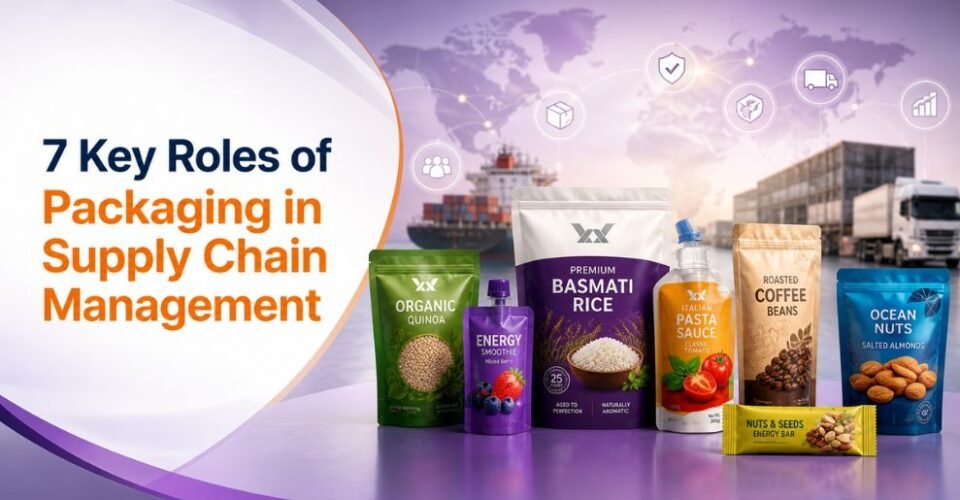
Every product that moves from a factory to a consumer’s hand passes through a complex network of processes, timelines, and handling stages. Packaging in supply chain management is what enables that movement to happen safely, efficiently, and without disruption at every step.
When packaging fails at any stage, the consequences are immediate and costly – product damage, contamination, regulatory issues, and loss of brand credibility. Flexible packaging, with its strong seals and high-barrier materials, reduces these risks by maintaining product integrity across varying supply chain conditions.
This makes packaging more than just a protective layer; it becomes a critical system that supports movement, storage, and delivery. To understand its role more clearly, it is essential to first define how supply chain management functions as a whole.
What Is Supply Chain Management?
Supply chain management refers to the coordinated process of moving a product from raw material sourcing to manufacturing, storage, distribution, and finally to the end consumer. It involves multiple stages where efficiency, timing, and product integrity are critical for overall business performance.
From a packaging perspective, this entire system depends on how well products are contained, protected, and handled at each stage. Packaging acts as the connecting layer that ensures consistency across movement, making it essential to understand the key roles of packaging in supply chain management.
Key Roles of Packaging in Supply Chain Management
Packaging plays a critical role at every stage of the supply chain, from protecting products during transit to supporting storage, handling, and final delivery. In modern operations, especially with flexible formats, packaging directly influences efficiency, cost, and product integrity across the entire system.
To understand the real impact of packaging in supply chain management, it is important to break down the specific roles it performs. The sections below explain how packaging contributes to protection, logistics, distribution, preservation, and overall supply chain performance.
1. Product Protection Throughout the Supply Chain
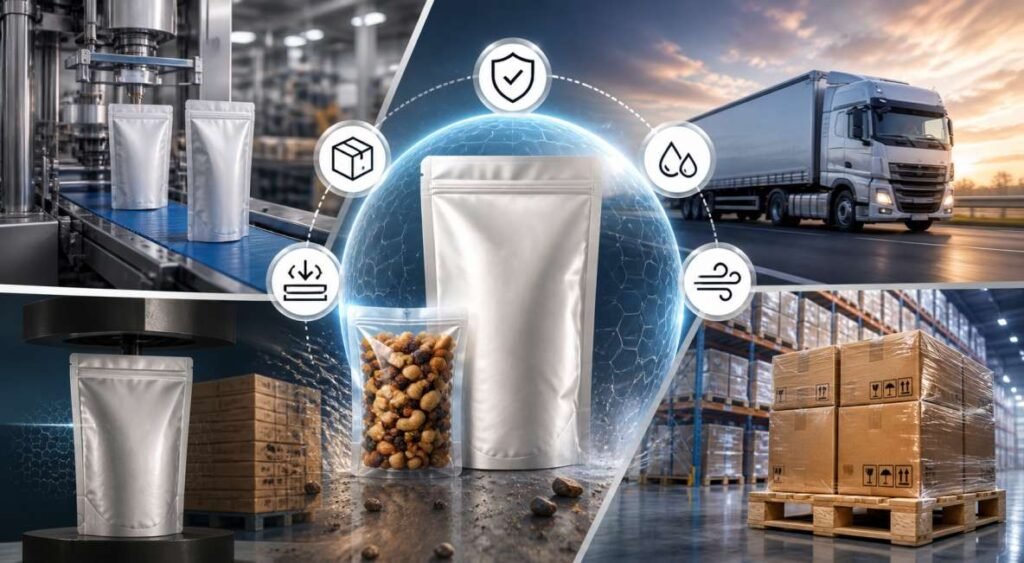
Product protection is the most critical function of packaging in supply chain management, ensuring that goods move safely from production to final delivery. Flexible packaging formats offer strong structural integrity and advanced barrier performance, making them highly effective across different handling and transport conditions.
Physical Protection During Transit
During transportation, products are exposed to impact, vibration, and compression. Flexible packaging absorbs these stresses better than rigid formats by adapting to product shape and reducing internal movement.
- Multi-layer laminates absorb impact without adding bulk
- Strong seals maintain integrity under compression and vibration
- Flexible formats conform to product shape — reducing void and movement
Barrier Protection Against Spoilage
Beyond physical safety, packaging must protect products from environmental factors such as moisture, oxygen, and light. Flexible packaging uses advanced laminate structures to create strong barriers that preserve product quality across the entire supply chain.
Formats like Flat Bottom Pouch provide both structural stability and high-barrier protection, making them ideal for products that require extended shelf life.
Multi-layer flexible laminates outperform rigid containers in barrier performance across every supply chain condition — a difference covered in detail in the benefits of flexible packaging over rigid containers.
2. Packaging in Logistics Management
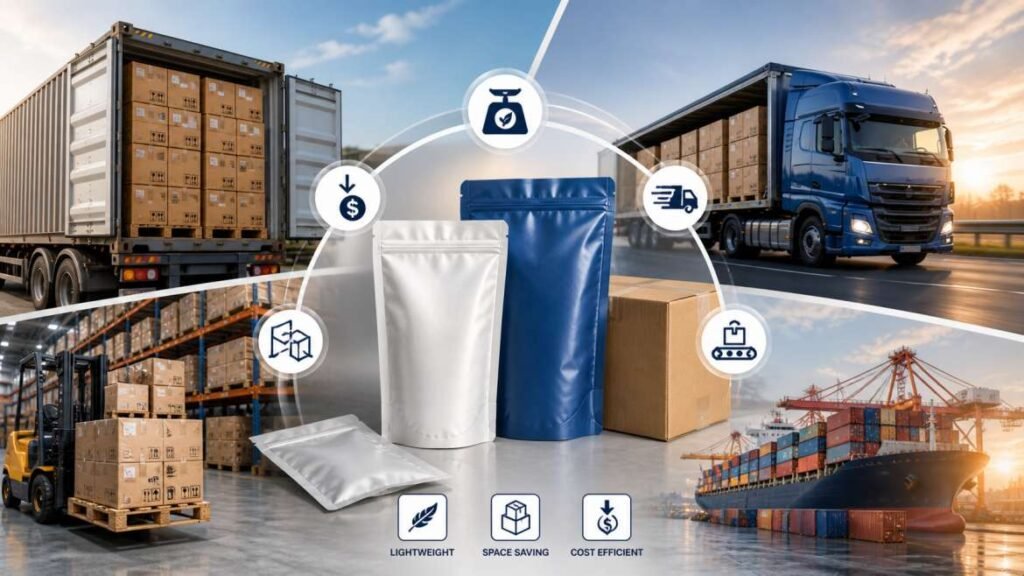
Efficient packaging in logistics management directly impacts transportation cost, handling speed, and delivery reliability. Flexible packaging formats improve logistics performance by reducing weight and optimizing space, making them more efficient than rigid alternatives across distribution networks.
Weight and Space Efficiency in Transit
Flexible packaging significantly reduces overall shipment weight, allowing more units to be transported in a single load. This improves cost efficiency while maintaining product safety across long-distance logistics operations.
Formats like 3 Side Seal Pouches offer compact structure and consistent sizing, helping maximize container utilization and streamline bulk transportation.
Handling Flexibility Across Logistics Formats
Flexible packaging adapts easily to both manual handling and automated systems, making it suitable for diverse logistics environments. Its lightweight and uniform structure simplify movement across warehouses and transport channels.
- Lightweight flexible packs reduce per-unit freight cost significantly
- Consistent flat profiles optimize pallet and container loading
- Flexible formats require less protective secondary material than rigid containers
3. Packaging and Distribution Management
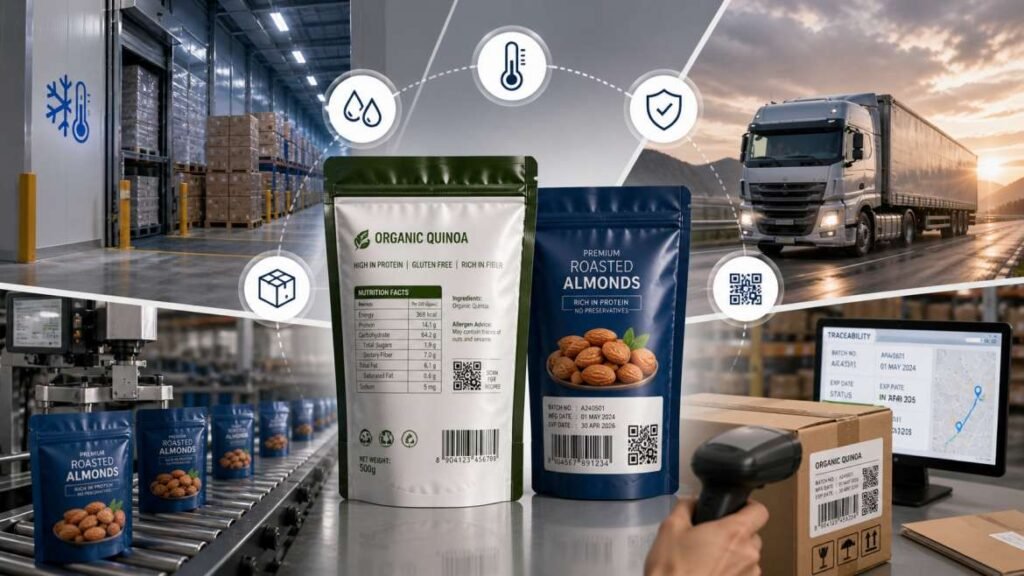
Effective packaging and distribution management ensures that products move smoothly across varying environments without compromising quality or compliance. Flexible packaging formats perform consistently across temperature changes, humidity, and handling stress, making them reliable for modern distribution networks.
Packaging That Performs Across Distribution Conditions
Products often pass through multiple environments before reaching the consumer. Flexible packaging is designed to withstand these variations, maintaining product integrity across different distribution stages.
Formats like 4 Side Seal Pouches offer strong sealing and high durability, making them suitable for products that require consistent protection during storage and transit.
Labeling, Traceability, and Compliance
Clear labeling and traceability are essential in distribution to ensure product identification, tracking, and regulatory compliance. Flexible packaging allows high-quality printing directly on the surface, improving visibility and reducing errors.
- High-resolution print on flexible films supports barcode and QR traceability
- Batch and expiry visibility reduces downstream compliance risk
- Regulatory labeling printed directly on laminate — no secondary label needed
4. Shelf Life Extension and Product Preservation
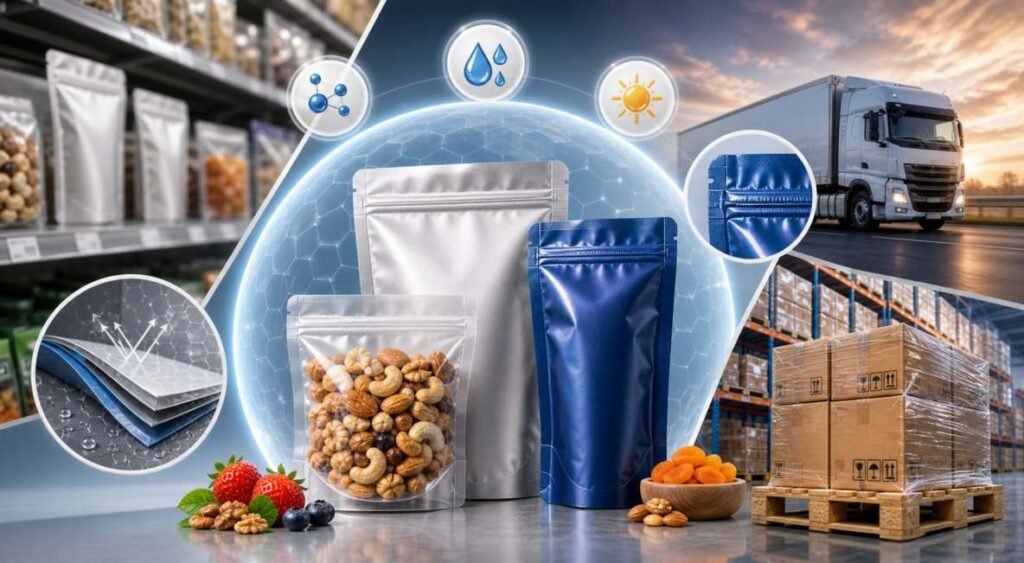
Extending product shelf life is a core function of packaging in supply chain management, especially for food and sensitive goods. Flexible packaging formats are designed to preserve freshness by controlling exposure to external elements throughout storage and distribution.
High-Barrier Flexible Films for Extended Freshness
Flexible packaging uses multi-layer laminate structures that block oxygen, moisture, and light, which are the primary causes of product degradation. This ensures that products remain fresh for longer without compromising quality.
Formats like Zipper Lock Pouch combine high-barrier protection with resealability, making them ideal for products that require both preservation and repeated use.
Seal Integrity Across the Supply Chain
Strong sealing ensures that products remain protected from the point of packaging to final consumption. Flexible packaging maintains seal strength even under varying supply chain conditions.
- Oxygen barrier films extend freshness without refrigeration
- Moisture-proof sealing prevents clumping in dry products
- Resealable formats extend usability post-purchase
5. Consumer Communication and Brand Visibility
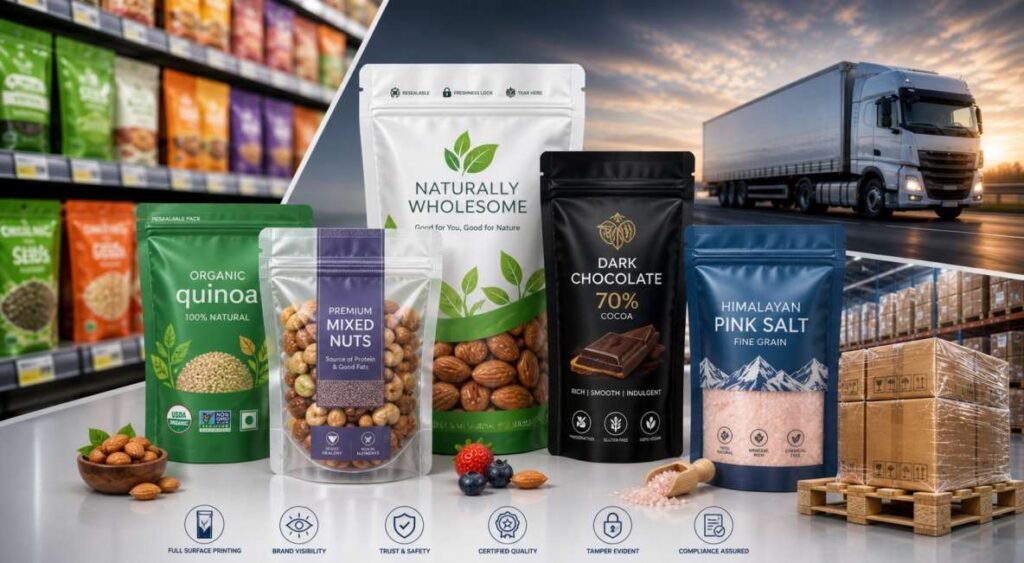
The importance of packaging in supply chain management goes beyond protection—it also defines how a product is perceived at the point of purchase. Flexible packaging formats enhance visibility, communicate value, and help brands stand out across retail environments.
Flexible Packaging as a Brand Communication Tool
Flexible packaging offers full-surface printing, allowing brands to communicate clearly through design, color, and messaging. This visual presence directly influences how consumers engage with products on the shelf.
The visual impact flexible packaging creates at the shelf directly shapes purchase decisions, as explored in how packaging affects consumer behavior.
Safety and Certification Signals on Flexible Packaging
Packaging also communicates trust through visible certifications, compliance labels, and quality indicators. These elements reassure buyers about product safety and regulatory alignment before purchase.
Manufacturers like White Lotus Industries Limited follow strict certification standards, ensuring that packaging reflects quality and compliance at every stage of the supply chain. Packaging that communicates compliance and quality on-pack is also one of the most effective marketing tools a brand owns — importance of packaging in marketing explains exactly why.
- Food-grade certification on-pack reduces retailer hesitation
- Tamper-evident features communicate product security visibly
- Compliance labeling printed directly on flexible laminate surface
6. Warehousing and Inventory Efficiency
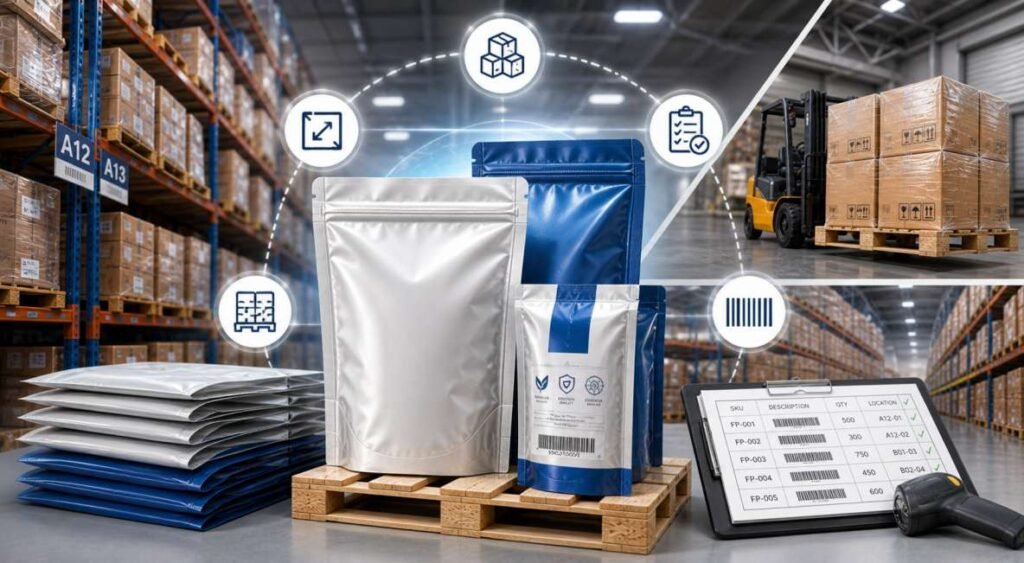
Efficient warehousing depends on how well packaging supports storage, handling, and inventory control. Flexible packaging formats improve warehouse operations by reducing space usage and simplifying stock management compared to rigid alternatives.
Space Optimization With Flexible Formats
Flexible packaging allows better space utilization due to its lightweight and compact structure. Unlike rigid containers, flexible packs can be stacked efficiently, reducing storage footprint and improving warehouse capacity.
Formats like Center Seal Gusset Pouch are designed for bulk storage while maintaining structural consistency. Choosing the right flexible format for storage efficiency starts with understanding the full range of types of packaging pouches available for food and non-food products.
Inventory Accuracy and Stock Management
Accurate inventory handling depends on clear labeling and uniform packaging dimensions. Flexible packaging simplifies tracking and improves operational efficiency across warehouse systems.
- Uniform flexible pack dimensions simplify warehouse slotting
- Lightweight packs enable higher density storage per square foot
- Clear printed labels on flexible surface aid fast stock identification
7. Sustainable Packaging in Modern Supply Chains
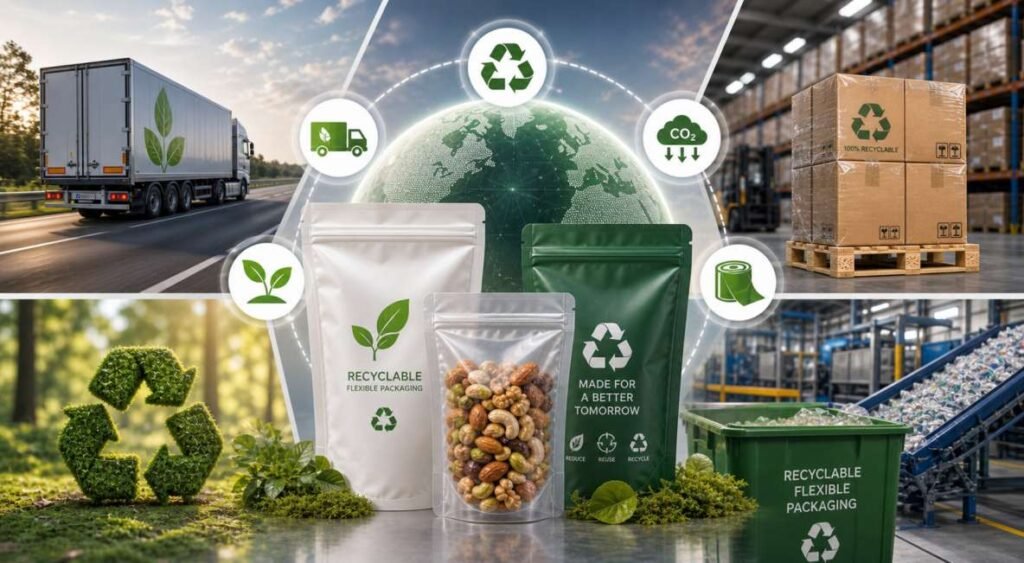
Sustainability is becoming a core requirement in modern supply chains, influencing how packaging is designed, used, and disposed of. Flexible packaging formats support this shift by reducing material usage and improving overall efficiency without compromising performance.
Lightweight Flexible Packaging Reduces Supply Chain Emissions
Flexible packaging significantly lowers transportation weight, which directly reduces fuel consumption and emissions across the supply chain. This makes it an effective solution for businesses aiming to improve operational sustainability.
Recyclable and Responsible Flexible Packaging Formats
Advancements in material science have made flexible packaging more recyclable and environmentally responsible. Brands are increasingly adopting these formats to align with regulatory and consumer expectations.
- Recyclable laminates reduce end-of-life packaging waste
- Mono-material structures simplify recycling for brand compliance
- Reduced material usage cuts cost and carbon across supply chain legs
Recyclable and mono-material flexible formats are rapidly becoming the baseline expectation, a shift well reflected in the latest food packaging trends reshaping supply chains globally.
Types of Packaging in Supply Chain Management
The types of packaging in supply chain management are typically divided into three levels—primary, secondary, and tertiary. Each level plays a specific role in protecting, grouping, and transporting products across different stages of the supply chain.
Flexible packaging formats perform efficiently across all three levels by reducing weight, improving storage, and maintaining product integrity better than rigid alternatives in most use cases.
Primary Packaging - Direct Product Contact
Primary packaging is the first layer that comes in direct contact with the product and is responsible for maintaining quality, safety, and freshness. In flexible packaging, high-barrier laminates and food-grade materials ensure protection against moisture, oxygen, and contamination.
Formats like Stand Up Pouches provide both protection and shelf appeal, making them highly effective for food and consumer goods that require durability and visual impact at the product level.
Secondary Packaging - Grouping and Retail
Secondary packaging groups multiple primary units together for easier handling, storage, and retail display. It also provides an additional layer of protection during transportation and stocking.
Flexible formats such as Center Seal Gusset Pouch reduce excess material usage compared to rigid boxes while maintaining structural efficiency and improving space utilization in retail and distribution environments.
Tertiary Packaging - Bulk and Transport
Tertiary packaging is used for bulk handling, storage, and transportation across long distances within the supply chain. It ensures that large quantities of products move safely through logistics networks.
Flexible solutions like Roll Form Packaging support high-speed automated packing lines, reduce material consumption, and improve efficiency in large-scale operations, making them ideal for modern supply chain requirements.
Importance of Packaging in Supply Chain Management - Key Takeaways
The role of packaging in supply chain management extends across multiple operational layers, from product protection to logistics efficiency and brand communication. Each function contributes to how smoothly products move and how consistently they perform across the supply chain.
Protection and Product Integrity
Packaging ensures that products remain safe from physical damage and environmental exposure throughout transit and storage. Flexible packaging formats strengthen this protection through barrier films and durable sealing.
Logistics Efficiency and Cost Optimization
The role of packaging in supply chain becomes highly visible in logistics, where lightweight and compact formats reduce transportation costs and improve load efficiency. Flexible packaging supports better space utilization across distribution networks.
Communication, Compliance, and Brand Value
Packaging also acts as a communication tool by displaying product information, certifications, and branding elements clearly. This improves traceability, builds trust, and enhances the overall value perception at the point of delivery and sale.
Sustainability and Long-Term Efficiency
Modern packaging solutions contribute to sustainability by reducing material usage and improving recyclability. Flexible packaging supports environmentally responsible supply chains while maintaining operational performance.
Common Packaging Challenges in Supply Chain Management
Even with structured systems in place, packaging in supply chain management often faces challenges that directly impact efficiency, cost, and product safety. These issues typically arise when packaging decisions are not aligned with product requirements or logistics conditions.
In many cases, the gap between packaging design and real-world supply chain demands leads to performance failures. Flexible packaging helps address these issues, but only when materials, formats, and usage are selected strategically.
- Incorrect material selection leads to product damage or reduced shelf life
- Over-packaging increases cost, weight, and logistics inefficiency
- Under-packaging results in leakage, contamination, or transit damage
- Poor sealing quality causes product loss across handling stages
- Inefficient packaging formats reduce storage and pallet optimization
- Lack of clear labeling affects traceability and compliance
- Incompatibility with automated systems slows down operations
How to Choose the Right Packaging for Supply Chain Efficiency
Choosing the right packaging is a critical decision in packaging in supply chain management, as it directly affects product safety, logistics performance, and overall cost efficiency. The right combination of material, format, and design ensures that products move smoothly across every stage of the supply chain.
Flexible packaging offers a wide range of solutions that can be tailored to product type, storage conditions, and distribution requirements. However, selecting the most effective option requires a clear understanding of operational needs and performance expectations.
Material Selection Based on Product Requirements
Different products require different levels of protection, and material selection plays a key role in ensuring performance. Flexible packaging materials can be customized to provide the right balance of strength, barrier protection, and cost efficiency.
- Choose high-barrier laminates for moisture- or oxygen-sensitive products
- Use food-grade materials for consumable goods to ensure safety and compliance
- Select puncture-resistant films for products exposed to rough handling
Format Selection Based on Logistics and Handling
Packaging format impacts how products are stored, transported, and handled across the supply chain. Selecting the right format improves efficiency and reduces operational complexity.
- Opt for lightweight formats to reduce transportation costs
- Choose stackable designs to improve warehouse space utilization
- Ensure compatibility with automated packing and handling systems
Balancing Cost, Performance, and Sustainability
The best packaging decisions balance cost efficiency with performance and environmental responsibility. Flexible packaging allows brands to achieve this balance without compromising product quality.
- Reduce material usage while maintaining strength and durability
- Consider recyclable or mono-material options for sustainability
- Evaluate long-term cost savings over short-term packaging expenses
Final Thoughts
Packaging is not just a cost in operations—it is a strategic layer that directly influences how efficiently a product moves through the supply chain. From protection to logistics and communication, every packaging decision impacts performance at multiple stages.
Each format choice, whether at the primary, secondary, or tertiary level, compounds across transportation, storage, and delivery. Flexible packaging, in particular, enhances efficiency by reducing weight, improving protection, and adapting to different supply chain requirements without adding complexity.
Manufacturers like White Lotus Industries Limited focus on combining material innovation with certified production standards to ensure consistency across large-scale operations. When approached correctly, packaging in supply chain management becomes a long-term advantage that supports reliability, cost control, and overall business growth.
Frequently Asked Questions (FAQs)
1. What is the role of packaging in supply chain management?
The role of packaging in supply chain management is to protect products, support logistics, and ensure smooth handling across every stage. It helps maintain product integrity, reduce damage, and improve efficiency in storage and transportation.
2. What are the types of packaging in logistics?
The main types of packaging in logistics include primary, secondary, and tertiary packaging. These levels work together to protect products, group them for handling, and enable bulk transportation across supply chain networks.
3. Why is packaging important in supply chain management?
The importance of packaging in supply chain management lies in its ability to reduce losses, improve operational efficiency, and support compliance. Well-designed packaging ensures safe delivery while optimizing storage and transportation costs.
4. How does packaging affect logistics and distribution efficiency?
Packaging directly impacts logistics by influencing weight, space utilization, and handling ease. Efficient packaging in logistics management improves load optimization, reduces freight costs, and simplifies distribution processes.
5. How do manufacturers ensure quality in supply chain packaging?
Experienced manufacturers like White Lotus Industries Limited focus on high-quality materials, strong sealing, and certified production standards. This ensures that packaging performs consistently across different supply chain conditions while maintaining product safety and reliability.
6 Comments
Грузоперевозки осуществляют решающую роль в хозяйстве любой государства.
Они поддерживают непрерывное снабжение складов и предприятий всеми требуемыми товарами.
Надёжная доставка способствует снижать время и расходы на доставку товаров, что повышает прибыльность предприятий.
В итоге, сектор перевозок считаются критическим звеном текущей экономической системы.
https://perevozimgruz.by/
Internet adventures bring players a superb avenue to socialize and relax with friends everywhere.
https://muview.ru/read-full/2026-06-23-kushva-posle-tornado-ochistka-ulits-i-spasatelnaya-rabota/
Плановый технический осмотр считается ключевой мерой для обеспечения надёжности транспортного средства.
При проверки находятся потенциальные дефекты, которые способны стать причиной серьёзных поломок на трассе.
Регулярное посещение ТО позволяет избежать серьёзных затрат на сложный восстановление позже.
Кроме того исправный транспорт обеспечивает спокойствие вашу и окружающих на пути.
Диагностическая карта
Коммерческая деятельность выступает значимым локомотивом прогресса общества.
Оно открывает новые рабочие места и даёт населению надёжный заработок.
белай тринфико
Кроме того, свое дело поощряет инновации и внедрение передовых технологий.
Таким образом, предпринимательство делает жизнь намного более динамичной и даёт путь для личностному росту.
La práctica responsable del juego se define como una filosofía que busca preservar el equilibrio respecto a la actividad de apostar y prevenir los problemas asociados a el juego.
Requiere fijar topes personales previo a empezar a jugar, así como identificar las señales que indican una posible adicción.
https://www.apkfiles.com/apk-622658/descargar-mobcash-apk-oficial-gesti-n-de-caja-m-vi
Asimismo, fomenta decisiones responsables y busca que la la diversión continúe siendo el propósito central al la actividad.
En resumen, esta práctica ayuda a las personas a preservar el dominio sobre sus hábitos y a vivir la experiencia de forma saludable.
На представленном портале легко отыскать массу полезных данных.
Тут размещены различные исследования на животрепещущие темы.
Любой пользователь имеет возможность изучить много полезного и обогатить свой багаж знаний.
Статьи периодически дополняются, дабы читатели неизменно имели возможность к самой актуальной информации.
https://sakhaday.ru/news/kabachki-kak-gruzdi-po-vkusu-ne-otlichish-recept-zakrutki-na-zimu