
Choosing the right flexible packaging manufacturer is an important decision for businesses that depend on packaging to protect their products, maintain quality, and create a strong brand impression. Whether you manufacture food products, pharmaceuticals, cosmetics, FMCG items, or industrial goods, packaging quality directly affects product safety, shelf life, storage, and customer satisfaction.
However, selecting a packaging manufacturer should not be based only on pricing, printing quality, or production capacity. A reliable manufacturer should also follow a structured quality assurance process that checks packaging materials, manufacturing operations, sealing performance, and finished products.
A proper quality assurance process helps identify potential defects before packaging reaches the customer. It also helps businesses maintain consistent packaging standards across different production batches.
In this guide, we will explain what to check in a flexible packaging manufacturer’s quality assurance process, how quality control works during manufacturing, and what questions businesses should ask before placing a bulk packaging order.
Why Is Quality Assurance Important in Flexible Packaging?
Quality assurance is an essential part of flexible packaging manufacturing. It helps ensure that packaging materials and finished products meet the required specifications and perform as expected during storage, transportation, and product use.
Flexible packaging often uses multiple layers of materials to provide strength, protection, printing quality, and sealing performance. If any layer or manufacturing process does not meet the required standards, the packaging may experience problems such as leakage, poor sealing, delamination, or reduced product protection.
For businesses, these issues can lead to product damage, customer complaints, packaging waste, and additional operational costs.
A strong flexible packaging quality assurance process helps businesses achieve the following benefits:
1. Improved Product Protection
Packaging is designed to protect products from external factors such as moisture, oxygen, light, dust, and physical damage. The required level of protection depends on the product being packed.
For example, food products may require moisture and oxygen barriers to maintain freshness, while pharmaceutical products may require specific material and hygiene requirements.
Quality checks help verify whether the selected packaging structure is suitable for the intended application.
2. Consistent Packaging Quality
Businesses need packaging that maintains consistent appearance, dimensions, material properties, and sealing performance across production batches.
Quality assurance helps identify variations during manufacturing and reduces the risk of receiving packaging that differs from the approved specifications.
3. Reduced Packaging Defects
Defects such as weak seals, incorrect dimensions, printing errors, and damaged laminate structures can affect packaging performance.
Identifying these issues during manufacturing can help reduce rework, material wastage, and unnecessary production delays.
4. Better Customer Satisfaction
Packaging is often the first physical interaction customers have with a product.
Good printing quality, reliable sealing, convenient pouch designs, and proper product protection contribute to a better customer experience.
5. Better Compliance and Documentation
Depending on the product and industry, packaging may need to meet specific safety, quality, and regulatory requirements.
A manufacturer should be able to provide relevant documentation, material specifications, test results, and applicable certifications when required.
What Should You Check in a Flexible Packaging Manufacturer’s Quality Assurance Process?
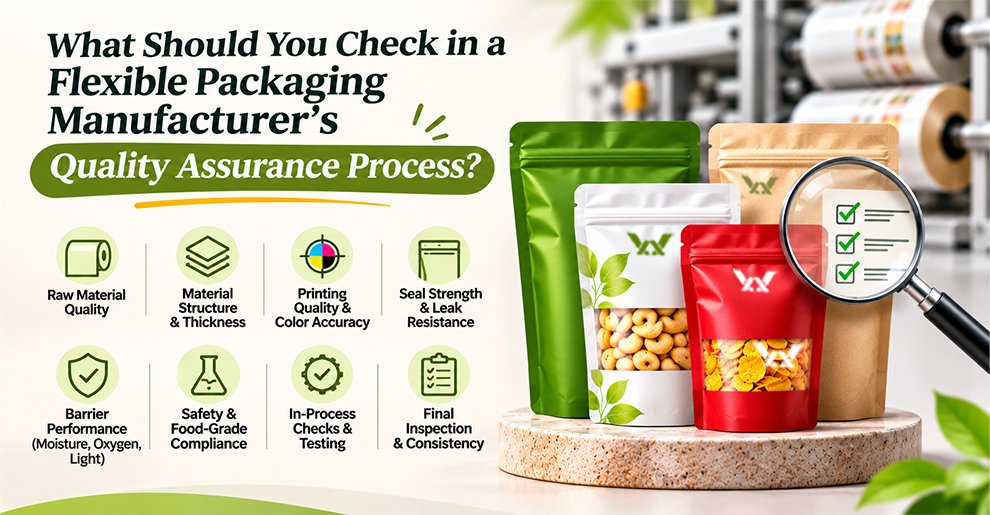
Before choosing a packaging supplier, businesses should evaluate the major quality checkpoints followed during manufacturing.
The following factors can help buyers understand whether a manufacturer has the necessary processes to deliver packaging that meets their requirements.
1. Raw Material Quality and Inspection
Raw material quality is the foundation of flexible packaging performance.
Packaging materials such as PET, PE, BOPP, metallized films, and aluminium foil may be used in different laminate structures depending on the product application.
Before production begins, buyers should check whether the manufacturer evaluates incoming materials according to the required specifications.
Important checks may include:
- Material thickness and consistency
- Film appearance and surface defects
- Material identification and traceability
- Supplier quality documentation
- Suitability for the intended packaging application
The material structure should be selected according to product characteristics, shelf life requirements, storage conditions, and filling processes.
Businesses that are still evaluating packaging materials can also explore this guide on what is flexible packaging material.
2. Printing Quality and Color Consistency
Printed packaging plays an important role in product branding and shelf presentation.
Poor printing quality can make packaging look unprofessional and may affect brand consistency across different batches.
A quality-focused manufacturer should inspect printed packaging for:
- Color consistency
- Printing registration accuracy
- Text and artwork clarity
- Logo placement
- Smudges, scratches, and ink defects
- Correct artwork and design specifications
For businesses using customized packaging, approved artwork and color references should be shared before production.
Printing inspections help ensure that the finished packaging matches the approved design and branding requirements.
3. Lamination Quality and Bond Strength
Flexible packaging often uses laminated materials to combine the properties of different films.
Lamination helps improve packaging strength, barrier performance, durability, and product protection. However, poor bonding between layers may result in delamination or reduced packaging performance.
Buyers should check whether the manufacturer evaluates:
- Lamination bond strength
- Adhesive application consistency
- Visible bubbles or wrinkles
- Layer separation
- Surface appearance
- Material compatibility
Bond strength testing helps evaluate the adhesion between laminated layers.
The required bond strength depends on the laminate structure, packaging application, and customer specifications.
4. Seal Strength and Leakage Testing
Seal integrity is one of the most important quality checks for flexible packaging.
Packaging seals help prevent product leakage, contamination, and exposure to external conditions. Weak seals may fail during filling, storage, transportation, or handling.
A flexible packaging manufacturer should evaluate sealing performance according to the intended product and packaging format.
Important quality checks include:
- Heat seal strength
- Seal uniformity
- Seal width and appearance
- Leakage testing where applicable
- Compatibility with filling equipment
- Seal performance under expected handling conditions
For liquid products, leakage testing becomes especially important.
For example, fruit juice packaging pouches need suitable material structures and reliable sealing performance to protect the contents during storage and transportation.
5. Barrier Properties and Product Protection
Barrier properties determine how effectively packaging materials protect products from external environmental factors.
Different products require different levels of protection.
For example:
- Snacks may require moisture and oxygen protection.
- Dry fruits may require suitable oxygen and moisture barriers.
- Pharmaceutical products may require specific protective packaging structures.
- Cosmetics may require material compatibility with the product formulation.
Buyers should ask the manufacturer whether the packaging material has been selected according to the required barrier performance.
Relevant testing may include:
- Water Vapour Transmission Rate (WVTR)
- Oxygen Transmission Rate (OTR)
- Moisture barrier performance
- Light protection requirements
The appropriate barrier specifications should be determined based on product sensitivity, expected shelf life, and storage conditions.
6. Packaging Dimensions and Structural Accuracy
Packaging dimensions directly affect product filling, sealing, storage, and transportation.
Incorrect pouch dimensions may cause filling difficulties, poor shelf presentation, or packaging failures.
Before placing a bulk order, buyers should verify:
- Pouch length and width
- Gusset dimensions
- Thickness specifications
- Seal position
- Zipper or spout placement
- Overall pouch structure
The manufacturer should follow approved drawings, samples, and specifications.
For businesses comparing different pouch formats, the guide on types of packaging pouches can help identify suitable packaging structures for different applications.
7. In-Process Quality Control Checks
Quality control should not be limited to the final stage of manufacturing.
During production, manufacturers should monitor important process parameters and identify defects as early as possible.
Depending on the manufacturing process, in-process inspections may include:
- Printing registration checks
- Lamination process monitoring
- Film thickness verification
- Seal temperature and pressure checks
- Pouch dimension inspection
- Visual defect identification
Regular monitoring helps maintain consistent production quality and reduces the possibility of defects continuing through the manufacturing process.
8. Finished Packaging Inspection
Finished packaging inspection is performed before products are approved for dispatch.
This stage helps confirm whether the packaging meets the agreed specifications and customer requirements.
Buyers should check whether the manufacturer inspects:
- Overall packaging appearance
- Printing quality
- Dimensions and thickness
- Seal integrity
- Lamination quality
- Functional features such as zippers or spouts
- Packaging quantity and identification
A reliable inspection process should follow documented acceptance criteria.
Businesses should also clarify whether inspection reports or test results can be shared for their orders.
9. Quality Testing Equipment and Calibration
Testing equipment plays an important role in evaluating flexible packaging performance.
A manufacturer with an appropriate quality testing laboratory can conduct relevant tests according to the packaging specifications.
Depending on the application, testing equipment may include:
- Bond Heat Seal Strength Tester
- Bursting Strength Tester
- Co-efficient of Friction Tester
- Dart Impact Tester
- Universal Tensile Testing Machine
- WVTR Humidity Tester
- Optical Density Tester
Buyers should also check whether testing equipment is maintained and calibrated periodically.
Calibration helps ensure that equipment measurements remain reliable and consistent.
10. Quality Certifications and Compliance
Quality certifications can help buyers evaluate a manufacturer’s quality management systems, food safety practices, and other relevant processes.
However, certifications should be checked according to the intended packaging application.
Before selecting a manufacturer, businesses should verify:
- Applicable quality management certifications
- Food safety certifications, where relevant
- Packaging material compliance documentation
- Current certification validity
- Scope of certification
- Required product-specific documentation
Certifications should not be treated as a replacement for product testing. Buyers should also review the packaging specifications and test results relevant to their products.
How Does a Flexible Packaging Manufacturer Maintain Quality Control?
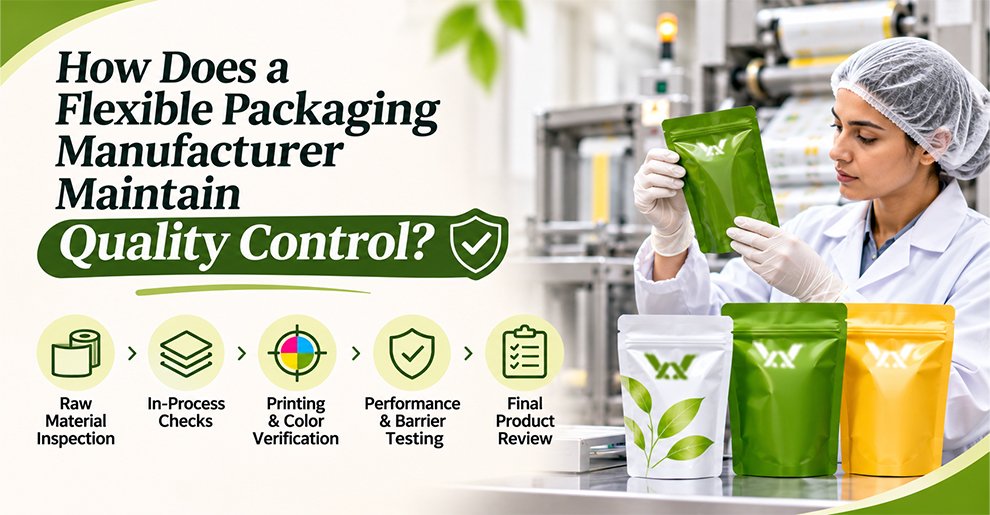
A structured flexible packaging quality control process involves monitoring quality at different stages of manufacturing.
The process may vary according to the packaging format, material structure, and customer specifications. However, the following stages provide a useful overview.
Quality Checks During the Manufacturing Process
The first stage involves checking raw materials and verifying that the selected materials meet the required specifications.
During printing, lamination, and pouch conversion, manufacturers should monitor relevant production parameters.
Regular inspections help identify defects such as printing errors, wrinkles, incorrect dimensions, and weak seals.
Testing Before Bulk Production
Before beginning large-scale production, businesses should approve packaging samples and confirm the specifications.
This may include reviewing:
- Packaging dimensions
- Material structure
- Printing artwork
- Color references
- Seal performance
- Functional features
Sample approval helps reduce the risk of misunderstandings between the manufacturer and the buyer.
Final Quality Approval Before Dispatch
After manufacturing, finished packaging should be inspected according to the approved quality criteria.
The final approval process may include visual inspection, dimensional checks, relevant performance testing, and quantity verification.
A documented inspection process helps maintain consistency and supports better communication between the manufacturer and the customer.
Questions to Ask Before Choosing a Flexible Packaging Manufacturer
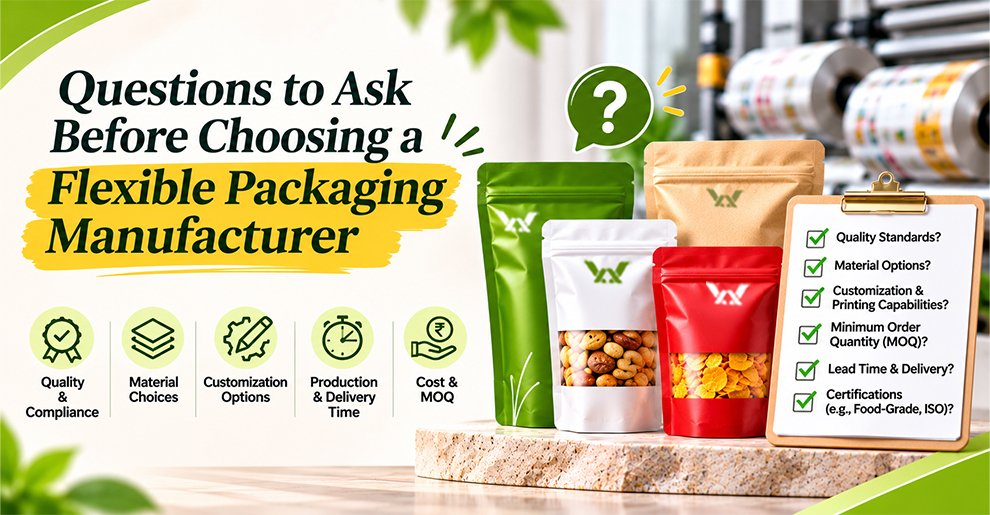
Selecting a packaging supplier requires more than comparing quotations.
Businesses should ask relevant questions to understand the manufacturer’s production capabilities, quality procedures, and ability to meet their packaging requirements.
Here are some important questions to ask before placing a bulk order.
Does the Manufacturer Have an In-House Quality Testing Lab?
An in-house quality testing laboratory can help a manufacturer conduct relevant tests during production and evaluate packaging performance.
Ask about the available testing equipment, inspection procedures, and whether testing reports can be provided.
What Packaging Quality Tests Are Performed?
Different products require different testing methods.
For example, food packaging may require barrier testing and seal strength evaluation, while industrial packaging may require additional strength and impact resistance checks.
The manufacturer should be able to explain which tests are relevant to your packaging application.
Can the Manufacturer Meet Your Packaging Specifications?
Before finalizing a supplier, confirm whether the manufacturer can produce the required pouch dimensions, material structure, printing design, and functional features.
Businesses should also discuss minimum order quantities, production timelines, sample approval, and delivery requirements.
How Are Packaging Defects Identified and Managed?
Ask the manufacturer how defects are identified during production and how corrective actions are handled.
A clear quality control procedure can help reduce the possibility of recurring packaging issues.
Can the Manufacturer Provide Relevant Certifications and Documentation?
Businesses should request applicable certifications, material specifications, and quality documents before placing an order.
The documentation should be relevant to the product, packaging application, and applicable requirements.
How White Lotus Industries Ensures Flexible Packaging Quality
White Lotus Industries focuses on manufacturing flexible laminates and customized packaging solutions for different industries. Its quality assurance approach includes inspection of raw materials, monitoring of production processes, and evaluation of finished products according to customer specifications.
The company has an in-house Quality Assurance laboratory equipped with testing instruments for evaluating different packaging properties.
Its published quality testing equipment includes a Bond Heat Seal Strength Tester, Bursting Strength Tester, Co-efficient of Friction Tester, Dart Impact Tester, Universal Tensile Testing Machine, and WVTR Humidity Tester.
White Lotus Industries also states that its machines and equipment are calibrated periodically and that finished products are inspected against customer-provided specifications before delivery.
Businesses looking for customized packaging can explore the company’s flexible packaging products to understand the available pouch formats and packaging options.
The company offers packaging formats such as stand-up pouches, flat-bottom pouches, center-seal pouches, zipper-lock pouches, spout pouches, and roll-form packaging.
For businesses evaluating different packaging structures, the stand-up pouch packaging solutions page provides additional information about this packaging format.
White Lotus Industries also provides customized packaging solutions based on different product and application requirements. Businesses can discuss their packaging specifications, material requirements, printing needs, and quality expectations before finalizing an order.
By evaluating the manufacturer’s testing capabilities, production processes, and product range, buyers can make a more informed decision when selecting a packaging partner.
Conclusion:
Selecting a reliable Flexible Packaging Manufacturer is an important step in maintaining product protection, packaging consistency, and customer satisfaction.
Before placing a bulk order, businesses should evaluate raw material quality, printing accuracy, lamination bond strength, seal integrity, barrier properties, packaging dimensions, testing equipment, and finished product inspection procedures.
A structured quality assurance process helps identify potential defects, maintain consistent packaging performance, and reduce the risk of manufacturing issues.
Businesses should also review applicable certifications, request samples, verify specifications, and discuss quality requirements with the manufacturer before production begins.
White Lotus Industries offers flexible packaging solutions supported by an in-house quality testing laboratory and documented quality assurance practices. Businesses looking for customized packaging can explore its product range and discuss their packaging requirements to identify a suitable solution.
Choosing a manufacturer based on quality, technical capabilities, and product suitability can help businesses build a dependable packaging supply chain.
Frequently Asked Questions
Q1: What Is Quality Assurance in Flexible Packaging?
Quality assurance in flexible packaging is a systematic process of ensuring that packaging materials and finished products meet the required quality specifications. It includes material inspection, manufacturing process monitoring, testing, and final product evaluation.
Q2: How Does a Flexible Packaging Manufacturer Test Packaging Quality?
A flexible packaging manufacturer may use different testing methods depending on the packaging application. These can include seal strength testing, tensile strength testing, bursting strength testing, barrier testing, dimensional inspection, and visual quality checks.
Q3: What Quality Tests Are Important for Flexible Packaging?
Important tests may include seal strength testing, lamination bond strength testing, tensile strength testing, coefficient of friction testing, WVTR testing, and dimensional inspection. The required tests depend on the packaging material and product application.
Q4: Why Is Seal Strength Testing Important in Flexible Packaging?
Seal strength testing helps evaluate the strength and reliability of packaging seals. Proper sealing performance can help reduce leakage, product exposure, and packaging failures during storage, transportation, and handling.
Q5: How Can You Choose a Reliable Flexible Packaging Manufacturer?
To choose a reliable manufacturer, evaluate its quality assurance process, testing equipment, material selection capabilities, production experience, relevant certifications, sample approval process, and ability to meet your packaging specifications.