
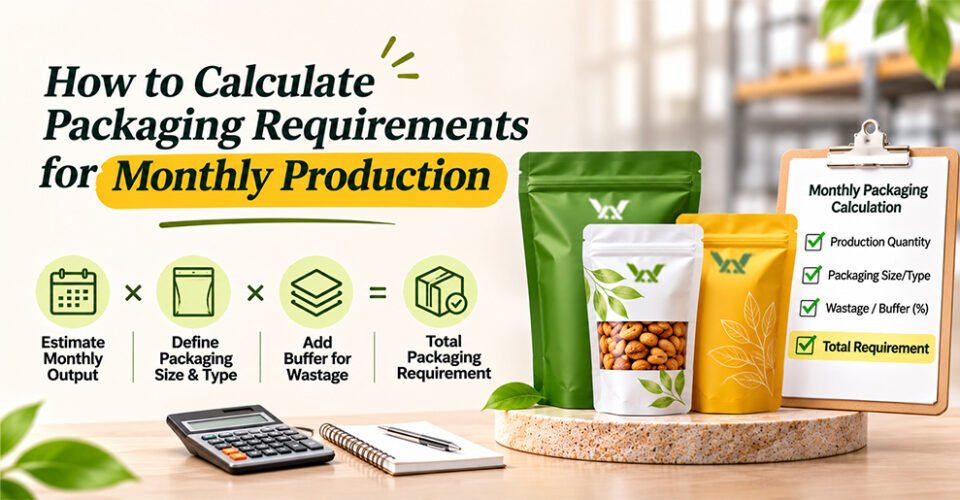
Packaging is an essential part of manufacturing because it protects products, maintains quality, and supports safe transportation. However, manufacturers must ensure that the right quantity of packaging material is available every month.
Ordering too little packaging can delay production, while ordering too much can increase storage costs and waste working capital. Therefore, businesses need to accurately calculate packaging requirements based on production volume, packaging specifications, wastage, and available inventory.
For manufacturers using flexible packaging pouches, laminated films, or roll-form packaging, proper planning helps maintain smooth production and control packaging costs.
Why Is It Important to Calculate Packaging Requirements for Monthly Production?
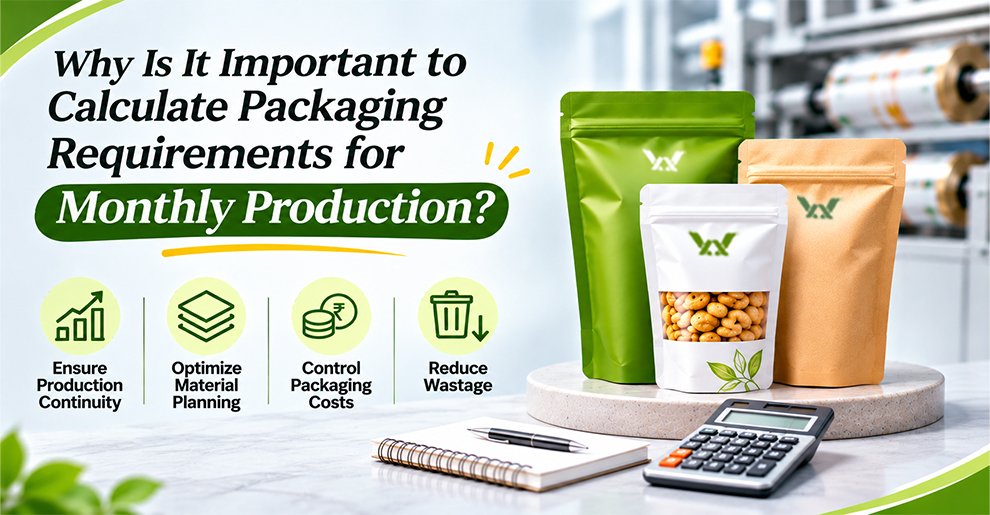
Accurate packaging planning helps manufacturers maintain sufficient material availability while avoiding unnecessary inventory.
Some important benefits include:
- Preventing Production Delays: Ensures packaging materials are available when required.
- Controlling Costs: Helps avoid excess inventory and unnecessary packaging purchases.
- Improving Inventory Management: Supports better stock monitoring and purchasing decisions.
- Reducing Material Waste: Helps manufacturers identify and control packaging wastage.
- Supporting Supplier Planning: Allows businesses to place orders according to production schedules and supplier lead times.
Proper packaging quantity calculation helps businesses manage their monthly production requirements more efficiently.
What Factors Affect Monthly Packaging Material Requirements?
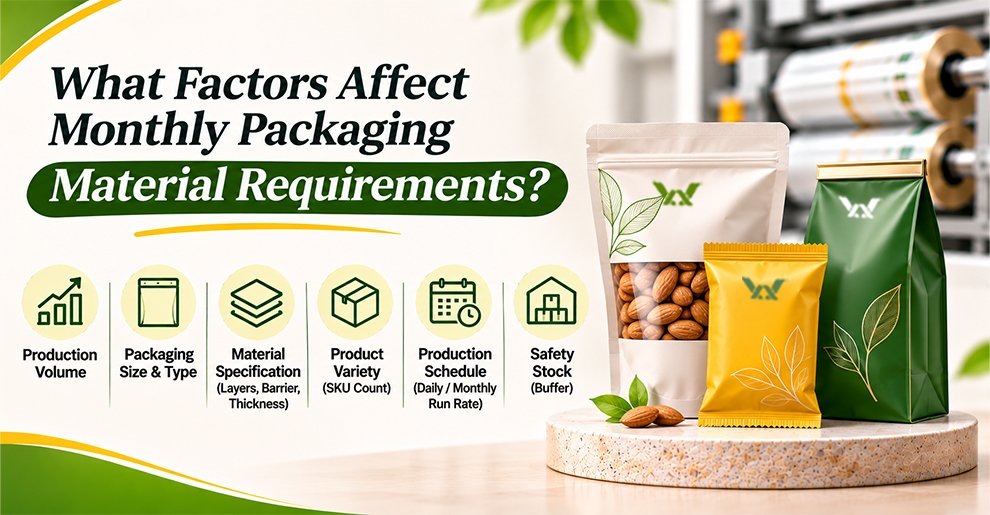
Several factors influence the total quantity of packaging material required for monthly production.
1. Monthly Production Volume
The total number of products manufactured each month determines the basic packaging requirement. For example, producing 50,000 units with one pouch per product requires 50,000 pouches before wastage.
2. Packaging Size and Format
Packaging formats such as stand-up pouches, flat-bottom pouches, spout pouches, and roll-form packaging have different material requirements.
Businesses should consider packaging dimensions, gusset size, and film specifications before calculating consumption.
Explore flexible packaging pouch options to understand different packaging formats.
3. Packaging Material Specifications
Material thickness, laminate structure, barrier properties, and product compatibility affect packaging selection.
Choosing the right material helps protect products and avoid unnecessary packaging costs.
4. Production Wastage
Packaging wastage may occur during machine setup, sealing, printing, or material handling. Manufacturers should include a realistic wastage allowance based on their production records.
5. Inventory and Supplier Lead Time
Existing usable packaging stock should be deducted from the total requirement. Businesses should also consider supplier lead time and safety stock to avoid shortages.
How to Calculate Packaging Requirements for Your Monthly Production Volume?
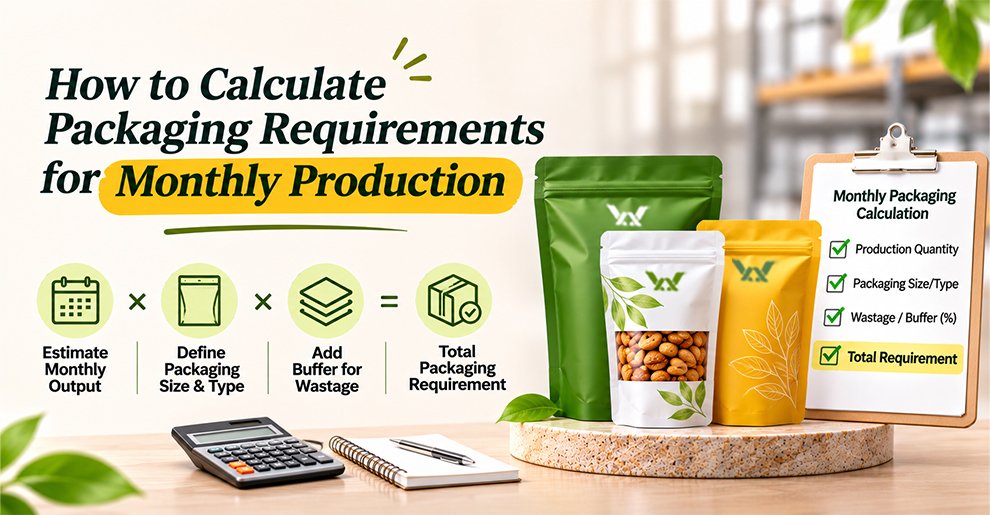
Manufacturers can follow a simple calculation process.
Step 1: Determine Your Monthly Production Target
Calculate the expected monthly production volume.
Monthly Production = Daily Production × Working Days
Example:
2,000 units × 25 working days = 50,000 units
Step 2: Identify Packaging Quantity Per Product
Determine how many packaging units are required for each finished product.
For example, if every product requires one pouch, the packaging requirement is equal to the production volume.
Step 3: Calculate Total Packaging Consumption
Packaging Quantity = Monthly Production Volume × Packaging Units Per Product
50,000 × 1 = 50,000 pouches
Step 4: Add Packaging Wastage
If the expected wastage rate is 3%:
50,000 × 3% = 1,500 pouches
Total packaging requirement:
50,000 + 1,500 = 51,500 pouches
Step 5: Adjust for Existing Inventory
If 5,000 usable pouches are already available:
51,500 − 5,000 = 46,500 pouches
Therefore, the manufacturer needs to order approximately 46,500 additional pouches, assuming no additional safety stock is required.
What Is the Formula for Packaging Material Requirement Calculation?
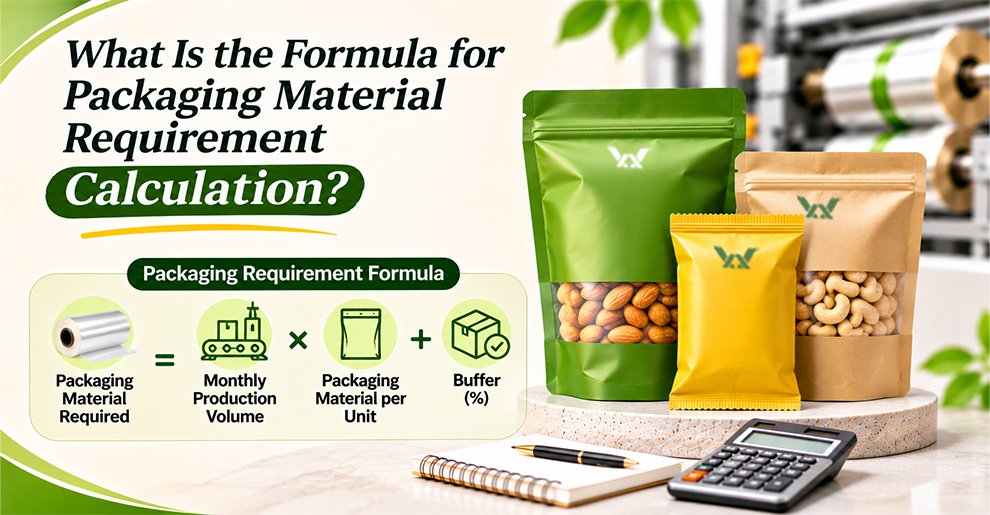
Manufacturers can use the following formulas to estimate their monthly packaging requirements.
Basic Packaging Quantity Calculation
Packaging Quantity = Monthly Production Volume × Packaging Units Per Product
Packaging Quantity Including Wastage
Total Packaging Requirement = Base Packaging Quantity × (1 + Wastage Rate)
Final Packaging Order Quantity
Packaging Order Quantity = Total Packaging Requirement + Safety Stock − Available Usable Inventory
For example:
| Parameter | Quantity |
|---|---|
| Monthly Packaging Requirement | 50,000 |
| Wastage Allowance (3%) | 1,500 |
| Safety Stock | 2,000 |
| Available Inventory | 5,000 |
| Final Order Quantity | 48,500 |
Calculation:
51,500 + 2,000 − 5,000 = 48,500 pouches
These formulas help manufacturers estimate packaging consumption and make better purchasing decisions.
How Can Manufacturers Improve Monthly Packaging Inventory Planning?
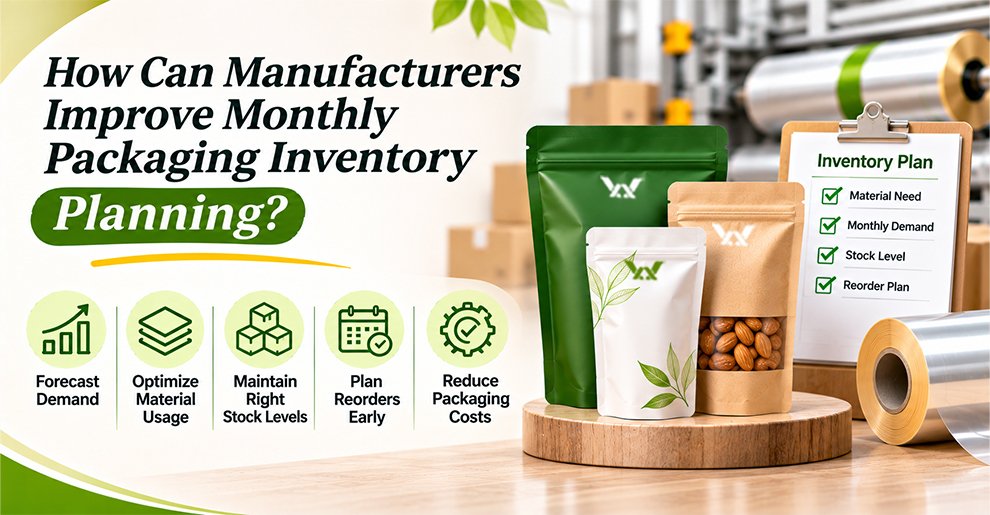
Effective packaging inventory planning helps manufacturers maintain sufficient material availability and reduce unnecessary storage costs.
Maintain Accurate Stock Records
Track packaging inventory by size, material, and specification to avoid shortages and excess stock.
Consider Supplier Lead Times
Place orders according to expected packaging consumption during the supplier’s production and delivery period.
Maintain Appropriate Safety Stock
Keep a reasonable quantity of additional packaging material to manage unexpected production increases or supplier delays.
Review Packaging Consumption Regularly
Compare planned and actual packaging consumption to identify wastage and improve future packaging material requirement calculation.
Common Mistakes to Avoid When Calculating Packaging Requirements
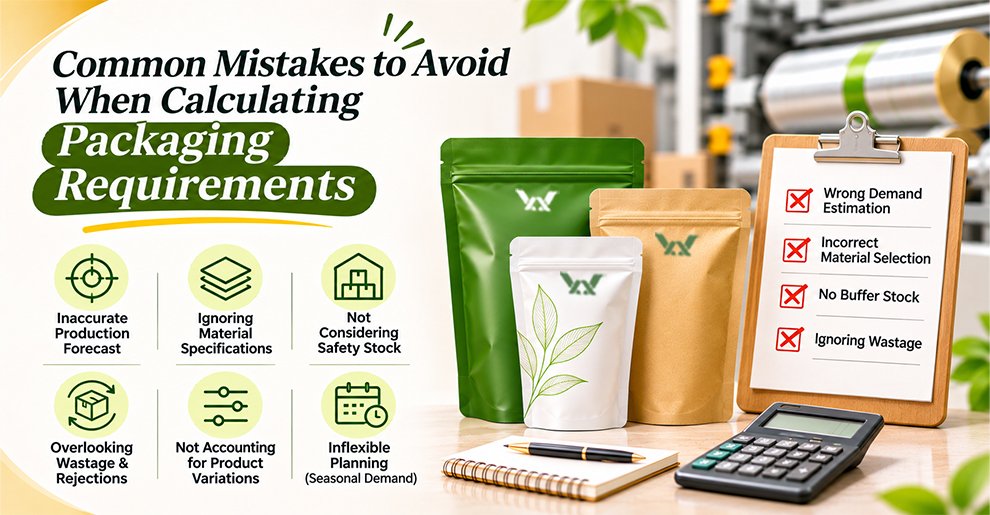
Manufacturers should avoid the following mistakes:
- Underestimating Wastage: Ignoring packaging losses may lead to material shortages.
- Ignoring Existing Inventory: Ordering without checking available stock can increase unnecessary expenses.
- Using Incorrect Specifications: Incorrect dimensions or material structures may result in unusable packaging.
- Ignoring Production Changes: Seasonal demand and production fluctuations can affect packaging consumption.
- Overlooking Supplier Lead Time: Late orders can interrupt production schedules.
Avoiding these mistakes helps manufacturers improve packaging planning and inventory management.
How to Choose the Right Flexible Packaging Manufacturer for Your Production Needs?
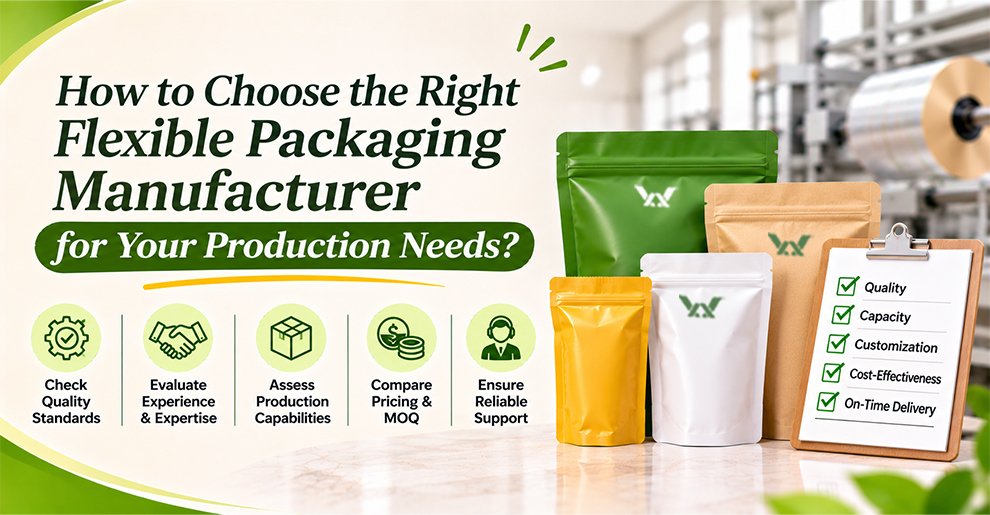
Choosing the right packaging supplier is important for maintaining consistent packaging quality and availability.
Manufacturers should evaluate suppliers based on:
- Manufacturing Capabilities: Ability to produce the required packaging formats and quantities.
- Material Quality: Suitable material structure, thickness, and product protection.
- Production Capacity: Ability to fulfill monthly and bulk packaging requirements.
- Delivery Reliability: Consistent delivery according to agreed timelines.
- Customization Options: Availability of customized sizes, printing, and packaging structures.
Businesses can also review custom packaging cost considerations before finalizing packaging specifications.
How White Lotus Industries Supports Your Packaging Requirements
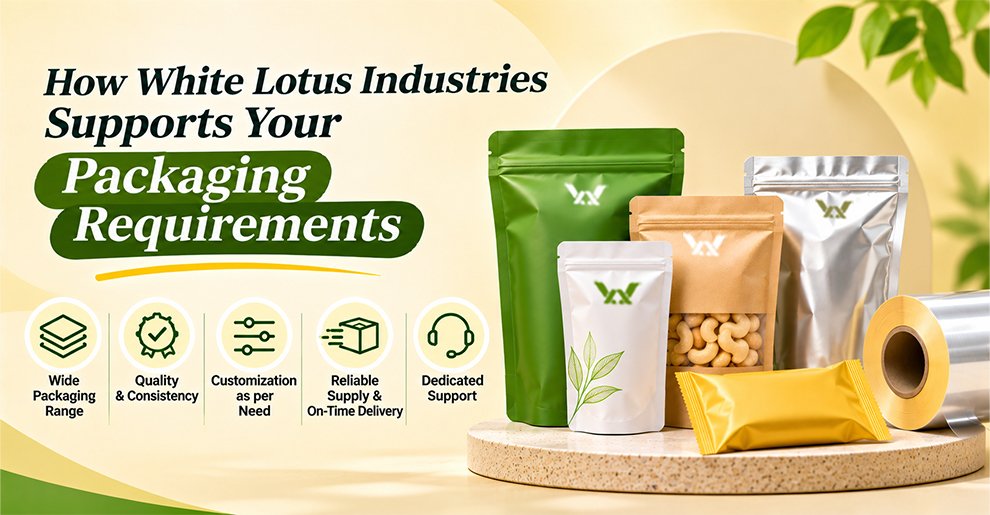
White Lotus Industries provides flexible packaging solutions for businesses across different industries. Its packaging options include stand-up pouches, flat-bottom pouches, spout pouches, laminated films, and roll-form packaging.
Manufacturers can evaluate packaging formats according to their product requirements, material specifications, and monthly production volume.
Selecting the right packaging material and confirming accurate specifications helps businesses improve packaging consumption planning and reduce unnecessary waste.
Explore the White Lotus Industries product to find suitable flexible packaging solutions for your business.
Conclusion
Calculating packaging requirements for monthly production helps manufacturers maintain sufficient inventory, control material wastage, and avoid production delays.
The process involves determining monthly production volume, identifying packaging quantity per product, estimating wastage, and adjusting for available inventory and safety stock.
By following a systematic packaging material requirement calculation process, businesses can improve purchasing decisions and maintain efficient production planning.
White Lotus Industries offers flexible packaging solutions that manufacturers can evaluate according to their product specifications and monthly packaging requirements.
FAQs
Q1: How do you calculate packaging requirements for monthly production?
Multiply monthly production volume by packaging units required per product. Add wastage and safety stock, then subtract available usable inventory.
Q2: How do you calculate packaging quantity for 10,000 products?
If each product requires one pouch, 10,000 products need 10,000 pouches. With 2% wastage, the total requirement becomes 10,200 pouches.
Q3: How do you calculate packaging material wastage?
Multiply the required packaging quantity by the estimated wastage percentage. For 50,000 pouches with 3% wastage, the additional requirement is 1,500 pouches.
Q4: How can manufacturers reduce packaging material waste?
Manufacturers can reduce packaging waste by selecting accurate packaging dimensions, improving machine settings, monitoring defective materials, and reviewing packaging consumption regularly.