
When businesses start looking for custom packaging, one of the first questions they ask is, “How much will it cost?” The answer is not as simple as quoting one fixed price. Custom packaging cost depends on several factors, including the packaging material, size, thickness, quantity, printing requirements, pouch format, barrier properties, finishing options, and delivery requirements.
For brands operating in food, FMCG, pharmaceuticals, personal care, nutraceuticals, and other industries, packaging needs to do more than simply hold a product. It should protect the contents, support shelf life, communicate the brand, and provide a convenient experience for customers.
This is why understanding the factors behind custom packaging cost in India can help businesses make better purchasing decisions and avoid comparing packaging quotations based only on the lowest price.
For flexible packaging in particular, there is no universal price because every project can have different material structures, pouch dimensions, printing requirements, and production quantities. White Lotus Industries develops customized flexible packaging solutions based on product requirements, performance expectations, and branding needs.
What Is Custom Packaging Cost?
Custom packaging cost refers to the total amount a business spends to manufacture packaging designed specifically for its product and brand.
Unlike standard packaging, custom packaging can be tailored according to:
- Product size and weight
- Packaging dimensions
- Material structure
- Thickness
- Pouch style
- Printing requirements
- Barrier protection
- Closure and opening features
- Surface finish
- Order quantity
- Production and setup requirements
For example, a simple three-side seal pouch for a small product may require less material and fewer production steps than a large stand-up pouch with a zipper, premium finish, and high-barrier laminate.
Therefore, businesses should not expect every custom packaging project to have the same price.
The better approach is to understand what is included in the quotation and which specifications are driving the cost.
If you are unfamiliar with different flexible packaging materials, it is useful to first understand what flexible packaging material is and how it works.
What Factors Affect Custom Packaging Cost in India?
Several factors influence the final price of custom packaging. Understanding these factors can help businesses choose packaging that provides the right balance between performance, appearance, and budget.
1. Packaging Material and Material Structure
Material is one of the most important factors affecting custom packaging cost.
Flexible packaging can use different substrates and laminated structures depending on the product’s requirements. Common materials include PET, BOPP, PE, CPP, metallized films, aluminium foil, Kraft paper, and multilayer laminates.
The right material depends on what the packaging needs to protect the product from.
For example:
- Snacks may require moisture and oxygen protection.
- Coffee may require strong aroma and oxygen barriers.
- Spices may require moisture, light, and aroma protection.
- Pharmaceutical products may require controlled protection and suitable food- or pharma-grade materials.
- Liquid products may require strong sealing and leak resistance.
Using a more advanced or higher-barrier structure can increase the packaging cost, but choosing a cheaper material that does not adequately protect the product can result in product spoilage, leakage, or reduced shelf life.
That is why material should be selected according to product requirements rather than price alone.
2. Packaging Size and Thickness
The dimensions and thickness of a pouch directly affect the amount of material required.
A larger pouch generally requires more film than a smaller pouch. Similarly, increasing the thickness of the laminate can increase material consumption.
For example, a pouch designed for a 1 kg product will generally require a different size and structure from a pouch designed for a 100 g product.
Businesses should therefore provide accurate information about:
- Product weight
- Product volume
- Required pouch dimensions
- Filling method
- Required strength
- Expected shelf life
Optimizing pouch dimensions can help avoid unnecessary material usage while still maintaining product protection.
3. Order Quantity and Minimum Order Quantity
Quantity can have a significant impact on the effective custom packaging cost per pouch.
Custom packaging often involves initial setup and production costs. When these costs are spread across a larger number of units, the effective cost per pouch can become more economical.
For example, a business ordering a large quantity of the same packaging design may achieve a better per-unit economics than a business ordering a very small quantity.
However, the ideal order quantity depends on:
- Product demand
- Storage capacity
- Number of SKUs
- Shelf life
- Cash flow
- Production planning
Businesses should avoid ordering excessively large quantities simply to reduce the unit cost if they do not have enough demand or storage capacity.
4. Printing and Artwork Requirements
Printing is another important component of custom packaging cost.
Brands often require packaging with detailed graphics, product information, nutritional information, branding elements, regulatory information, and multiple colours.
The final cost can be influenced by:
- Printing method
- Number of colours
- Artwork complexity
- Print coverage
- Number of designs or SKUs
- Printing setup requirements
For larger production volumes, the economics of the printing process can differ from small-batch requirements.
It is also important to remember that every additional packaging design or SKU can affect setup requirements. Businesses with many product variants should plan their packaging range carefully before production.
5. Pouch Style and Packaging Format
The type of pouch selected also affects custom packaging cost.
Different pouch formats require different amounts of material and different conversion processes.
Common formats include:
- Stand-up pouches
- Three-side seal pouches
- Centre seal pouches
- Flat-bottom pouches
- Side gusset pouches
- Spout pouches
- Shaped pouches
For example, three-side seal pouches have a relatively simple flat structure and can be suitable for smaller packs and single-use products. Stand-up pouches add a bottom gusset that allows the pouch to remain upright and provides stronger shelf presentation.
You can learn more about different formats in this guide to types of packaging pouches for food and non-food products.
6. Barrier and Protection Requirements
Not every product requires the same level of protection.
Packaging may need to provide resistance against:
- Moisture
- Oxygen
- Light
- Aroma loss
- Grease
- Contamination
- Physical damage
For products that are sensitive to moisture, oxygen, or light, a higher-barrier laminate may be required.
Although a high-barrier structure can increase the initial packaging investment, it can also help protect product quality and extend shelf life.
For example, snack products can lose their crispness when exposed to moisture, while coffee can lose aroma and freshness when exposed to oxygen.
Therefore, the cheapest material is not necessarily the most cost-effective option.
7. Custom Packaging Features and Finishes
Additional features can increase the manufacturing complexity and therefore influence custom packaging cost.
Depending on the product and customer requirements, businesses may choose features such as:
- Zipper closures
- Tear notches
- Spouts
- Handles
- Transparent windows
- Matte finishes
- Gloss finishes
- Special shapes
- Easy-open features
These features can improve convenience and shelf appeal, but they should be selected according to the product’s actual requirements.
For example, a resealable zipper can be valuable for products that customers use multiple times, while a spout can be particularly useful for liquid products.
For inspiration on modern packaging applications, explore these food and beverage packaging ideas.
8. Design, Sampling and Production Setup Costs
Custom packaging may also involve costs related to design preparation, sampling, testing, and production setup.
Before mass production begins, businesses may need to finalize:
- Packaging dimensions
- Artwork
- Material structure
- Printing specifications
- Sealing requirements
- Features and finishes
- Product compatibility
Sampling can help identify potential issues before a large production run.
This is particularly important for new products because making changes after mass production has started can be more expensive than identifying the issue during the sampling stage.
9. Delivery and Logistics Costs
The final packaging budget should not focus only on the manufacturing price.
Transportation and logistics can also influence the overall cost, depending on:
- Order quantity
- Delivery location
- Packaging volume
- Shipment method
- Delivery requirements
Flexible packaging can offer logistical advantages because it is generally lightweight and space-efficient compared with many rigid packaging formats.
Therefore, businesses should consider the total packaging cost, including production and logistics, rather than looking only at the basic manufacturing rate.
How to Reduce Custom Packaging Cost Without Compromising Quality
Reducing packaging expenses does not necessarily mean choosing the cheapest material or removing important features.
The goal should be to optimize packaging without compromising product protection, functionality, or brand presentation.
Choose the Right Packaging Material
Work with a packaging manufacturer to identify the material structure that provides the required barrier and strength without unnecessary material layers.
Using more material than necessary can increase costs, while using insufficient material can create performance problems.
Optimize Packaging Size and Thickness
Avoid oversized packaging when a smaller format can safely accommodate the product.
Similarly, packaging thickness should be selected based on product requirements, filling conditions, transportation, and sealing performance.
Plan Order Quantities Carefully
If demand is predictable, larger production quantities may improve per-unit economics.
However, businesses should balance this against storage requirements, cash flow, and product demand.
Avoid Unnecessary Custom Features
Zippers, windows, special finishes, spouts, and unusual shapes can improve functionality and appearance, but not every product requires all of them.
Choose features that genuinely improve the customer’s experience or product performance.
Reduce Unnecessary SKU Complexity
Brands with many packaging designs can face additional setup and production requirements.
Where practical, maintaining a consistent packaging structure across product variants can simplify procurement and production planning.
Choose an Experienced Packaging Manufacturer
An experienced manufacturer can help identify opportunities to optimize the material structure, pouch format, dimensions, and features.
This is often more valuable than simply searching for the lowest quotation.
For more information about selecting the right format, see this guide on how to choose the right flexible packaging pouch.
Custom Packaging Cost vs. Standard Packaging Cost
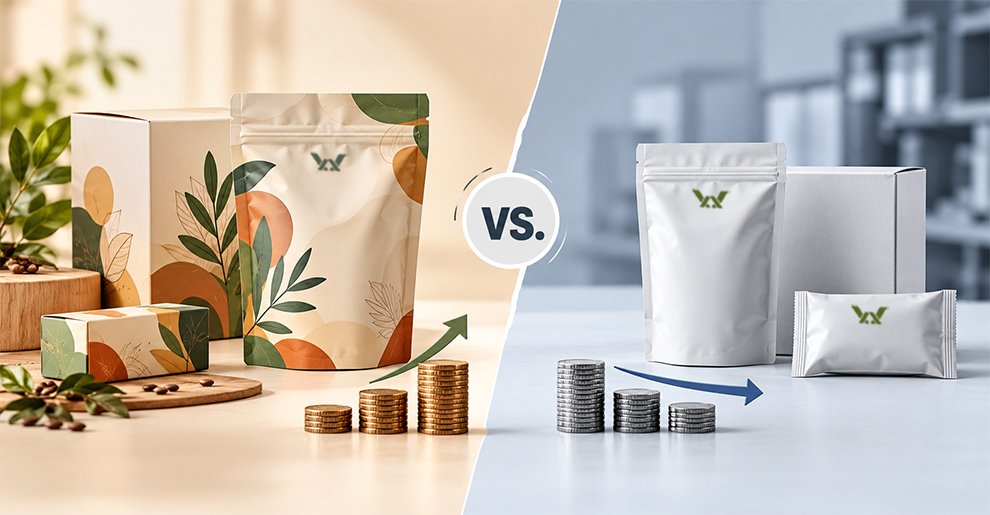
Custom and standard packaging serve different purposes, so the cheapest option is not always the best option.
| Factor | Custom Packaging | Standard Packaging |
|---|---|---|
| Design | Brand-specific | Limited or predefined |
| Size | Customized | Usually fixed |
| Material | Selected according to product needs | Limited options |
| Printing | Customized branding | Basic or limited |
| Features | Can include zippers, spouts, windows, etc. | Usually standard |
| Shelf Appeal | Highly customizable | More limited |
| Initial Setup | Can be higher | Generally lower |
| Product Protection | Can be engineered for the product | May have limited options |
| Brand Differentiation | High | Lower |
Standard packaging may work well for businesses with simple requirements. However, custom packaging can provide greater control over product protection, dimensions, branding, and consumer convenience.
The right choice depends on the product, target market, expected volume, and packaging objectives.
How to Get an Accurate Custom Packaging Quote in India
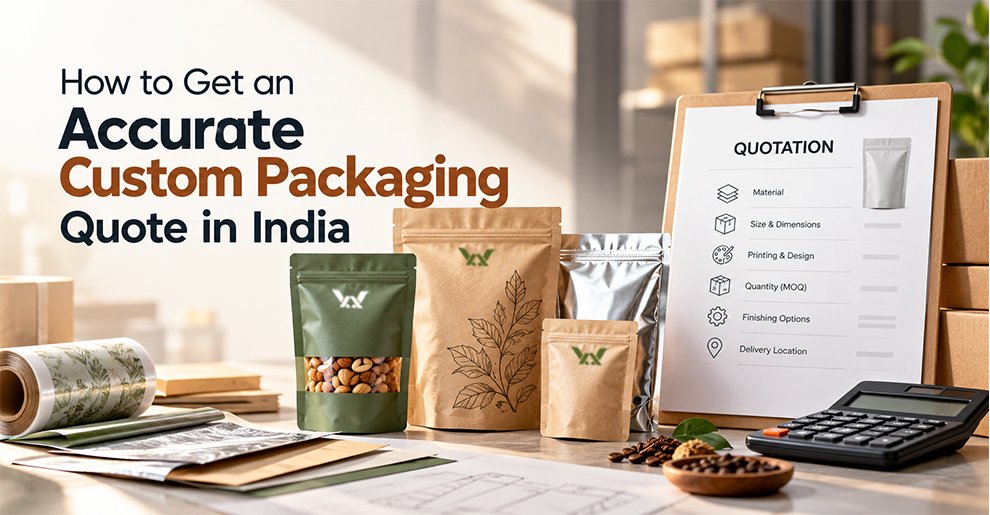
To receive a useful and accurate packaging quotation, businesses should provide as much information as possible to the manufacturer.
Important details include:
Product Information
Tell the manufacturer what you are packaging and whether it is solid, powder, liquid, oily, moisture-sensitive, or otherwise sensitive.
Product Weight or Fill Volume
Specify the required filling quantity, such as 50 g, 100 g, 500 g, 1 kg, or a specific liquid volume.
Packaging Size
Provide the required dimensions or discuss the recommended dimensions with the packaging manufacturer.
Packaging Format
Mention whether you need:
- Stand-up pouch
- Three-side seal pouch
- Centre seal pouch
- Flat-bottom pouch
- Side gusset pouch
- Spout pouch
- Shaped pouch
Material Requirements
If you already have a preferred material structure, share it. Otherwise, ask the manufacturer to recommend a suitable structure based on product requirements.
Printing Requirements
Provide the artwork, number of designs, colour requirements, and preferred finish if available.
Quantity
Mention your expected order quantity and number of SKUs.
Delivery Location
Provide the delivery location so that logistics can be considered when evaluating the overall quotation.
A detailed specification allows manufacturers to provide a more meaningful quotation and makes it easier for businesses to compare different suppliers.
Why Choose White Lotus Industries for Custom Packaging?
Choosing the right packaging manufacturer is an important part of controlling both packaging quality and overall cost.
White Lotus Industries has been operating in the flexible packaging sector since 2011 and provides customized flexible laminates and pouch solutions for different industries. Its capabilities include custom pouch formats, high-barrier protection, recyclable packaging structures, and food- and pharmaceutical-grade films.
The company focuses on developing packaging according to the product and application rather than relying on a one-size-fits-all solution.
Businesses can explore options such as:
- Stand-up pouches
- Flat-bottom pouches
- Centre seal pouches
- Three-side seal pouches
- Side gusset pouches
- Spout pouches
- Shaped pouches
- Roll-form packaging
The selection of the right packaging structure can help businesses balance protection, functionality, branding, and cost. White Lotus Industries also provides customized material and structural solutions based on product requirements.
For businesses comparing different packaging options, working with an experienced manufacturer can make the quotation process easier because material selection, pouch design, printing, barrier requirements, and production requirements can be evaluated together.
You can also explore White Lotus Industries’ flexible packaging solutions to understand the available packaging formats and applications.
Conclusion
Custom packaging cost in India depends on much more than the price of the packaging material. Size, thickness, material structure, order quantity, printing, pouch format, barrier requirements, finishing, additional features, setup, and logistics can all influence the final quotation.
Instead of selecting a supplier based only on the lowest price, businesses should evaluate the complete value offered by the packaging solution.
The right packaging should provide the necessary product protection, maintain quality and shelf life, support efficient transportation, improve customer convenience, and represent the brand effectively.
By optimizing the material structure, pouch size, quantity, printing, and features, businesses can manage custom packaging cost while maintaining the quality and functionality their products require.
For businesses looking for customized flexible packaging solutions in India, White Lotus Industries can help evaluate packaging requirements and develop solutions based on the product, application, and performance expectations.
FAQs
Q1. How much does custom packaging cost in India?
The cost of custom packaging in India varies depending on the material, pouch size, thickness, order quantity, printing requirements, packaging format, features, and barrier properties. Because every packaging project has different specifications, manufacturers generally provide quotations based on the specific requirements.
Q2. What factors affect custom packaging cost the most?
The major factors include packaging material, size, thickness, order quantity, printing, pouch style, barrier requirements, additional features, finishing, production setup, and logistics. Changing any of these specifications can affect the final packaging cost.
Q3. Is custom packaging more expensive than standard packaging?
Custom packaging can have a higher initial cost because it may require customized designs, printing, tooling, sampling, and specific material structures. However, it can provide better product protection, branding, functionality, and shelf appeal, which can make it more valuable for many businesses.
Q4. Does order quantity affect custom packaging cost?
Yes. Order quantity can significantly influence the effective per-unit cost. Larger production quantities may help distribute setup and production costs across more units, potentially making the packaging more economical per piece.
Q5. Does packaging material affect the final cost?
Yes. Different materials and laminate structures have different costs and performance characteristics. Materials should be selected according to the product’s requirements for moisture, oxygen, light, aroma, strength, and shelf-life protection.