
If you have asked three suppliers for the price of a printed pouch for masala packing, you have probably received three very different answers. One quotes per kilogram, another per piece, and a third adds a “cylinder charge” you were not expecting. Comparing them feels impossible.
The confusion is normal. Flexible packaging is priced on material weight, print setup and conversion work, not on a fixed catalogue price. A 50 g pouch of turmeric and a 500 g stand-up zipper pouch of garam masala can come from the same factory at very different costs.
This guide explains how a printed masala packaging pouch is actually priced in India. You will learn how to convert a per-kg quote into a per-pouch cost, which ten factors move the price up or down, how compliance rules affect your artwork, and how to compare quotes on equal terms. By the end, you should be able to
What Does a Printed Masala Pouch Cost?
There is no single price for a printed pouch for masala packing. The cost per pouch depends mainly on the material structure, pouch size and thickness, pouch style, printing method, number of colours, order quantity and add-ons such as zippers. Most Indian converters quote laminated pouches per kilogram, then add one-time cylinder or plate charges and 18% GST.
Key takeaways:
- Per-kg pricing means bigger and thicker pouches cost more per piece, even at the same rate.
- Rotogravure has a one-time cylinder cost per colour but a low running cost, so it suits large volumes. Digital printing has no cylinders and suits small runs and trials.
- Every new design or SKU can need new cylinders, so plan your range before printing.
- Always compare quotes on landed cost per usable pouch, not on the headline rate.
How Printed Masala Pouches Are Priced in India
Before looking at individual factors, it helps to understand the pricing model itself. Most confusion between quotes comes from suppliers using different units, not from large differences in actual cost.
Per kg vs per piece
Laminated pouches are made from rolls of multi-layer film. Because the converter buys film by weight and spends machine time per metre, many Indian manufacturers quote printed pouches per kilogram. Others, especially for small runs or digital printing, quote per piece.
Neither method is better. What matters is converting both into the same unit, which is cost per usable pouch, before you compare.
The total cost formula
A practical way to estimate your total spend on any order is:
Total landed cost = (pouch rate × quantity) + one-time cylinder or plate charges + artwork or proofing charges + freight + GST
Then divide by the number of pouches you will actually use:
Effective cost per pouch = total landed cost ÷ usable pouches received
Including one-time charges in the first order makes the first batch look expensive. Spreading them across the expected lifetime volume of a design gives a fairer picture, because cylinders are typically reused for repeat orders.
Worked example: converting a per-kg quote into cost per pouch
The example below uses real geometry and material densities, but the rate is an illustrative assumption, not a quote. Use your supplier’s actual figures.
Pouch: Three-side seal, 120 mm × 180 mm, for roughly 100 g of ground masala Structure: PET 12 micron / Metallised PET 12 micron / LDPE 60 micron
- Calculate the film area per pouch. Two faces × 0.12 m × 0.18 m = 0.0432 m².
- Estimate the laminate weight (GSM). PET at about 1.4 g/cm³ gives roughly 17 GSM for each 12-micron layer. LDPE at about 0.92 g/cm³ gives roughly 55 GSM for 60 micron. Adding around 8 GSM for inks and adhesive brings the total to roughly 97 GSM.
- Calculate the weight per pouch. 0.0432 m² × 97 g/m² ≈ 4.2 g.
- Find pouches per kg. 1,000 g ÷ 4.2 g ≈ 238 pouches per kg (before allowing for trim waste).
- Convert the rate. If a supplier quoted ₹250 per kg (assumed for this example), the pouch cost is about ₹250 ÷ 238 ≈ ₹1.05 per pouch, before cylinders, freight and GST.
Two things follow from this. A thicker LDPE layer or a larger size changes the pouches-per-kg figure directly, so it changes your per-piece cost even if the per-kg rate stays the same. And when you compare a per-kg quote with a per-piece quote, ask each supplier to confirm the pouches-per-kg figure they are using.
10 Key Factors That Affect B2B Pricing
Each of the following changes either the amount of material in the pouch, the setup cost of the job, or the machine time needed to make it.
1. Pouch style
The format of a printed masala packaging pouch affects how much film it uses and how complex it is to convert.
- Centre-seal (pillow) pouches are usually the most economical, and are common for small sachets and form-fill-seal lines.
- Three-side seal pouches are simple and widely used for 50 g–200 g masala packs.
- Stand-up pouches (doypacks) need a bottom gusset, which adds film and conversion steps, but they stand on shelves and look more premium.
- Side-gusseted and flat-bottom (box) pouches use the most film and the most complex sealing, and are usually chosen for larger packs or premium positioning.
If you are exploring formats beyond the standard flat pack, it can help to look at how snack brands use different pouch shapes and features, since many of the same structures work for spices.
2. Material structure and number of layers
This is often the single biggest cost driver. Ground spices lose their volatile oils and aroma over time, absorb moisture and can fade in light. The barrier you need decides the structure.
Common structures for a pouch for spices packaging include:
- PET / LDPE: Basic two-layer laminate with moderate barrier. Clear or printed.
- PET / Metallised PET / LDPE: Better barrier against light, moisture and oxygen. Widely used for ground masala.
- PET / Aluminium foil / LDPE: Highest barrier among common options, often used for strongly aromatic products. Usually the costliest of the three.
- Kraft paper / LDPE or paper-based laminates: Chosen for a natural look. Barrier depends on the inner layers.
- Mono-material PE structures: Designed to be easier to recycle. Barrier and print performance should be tested for your product.
Each added layer adds material, adhesive and a lamination pass. So moving from two to three layers raises cost, but it can protect shelf life and reduce returns from caked or faded product.
3. Pouch size and thickness
Because pricing is linked to weight, size and thickness affect cost directly. A 200 g pouch uses roughly twice the film of a 100 g pouch. Increasing the sealant layer from 60 to 80 micron adds weight to every single pouch.
Do not reduce thickness only to save money. Whole spices such as cloves, cinnamon sticks and star anise have sharp edges that can puncture thin films, and heavier packs put more stress on seals. The right thickness is the lowest one that passes your drop and puncture checks.
4. Order quantity and MOQ
Every job has fixed setup work: cylinder mounting, colour matching, machine make-ready and start-up waste. On a small order, that setup is spread across fewer pouches, so the per-piece cost is higher.
Rotogravure printers usually set a minimum order quantity (MOQ), often expressed in kilograms or a number of pouches per design. Digital printing allows much smaller runs. MOQs vary widely between manufacturers, so ask for the MOQ per design, not just per order.
5. Printing method
The printing method changes both setup cost and running cost.
| Printing Method | Setup Cost | Running Cost Per Pouch | Best For | Main Limitation |
|---|---|---|---|---|
| Rotogravure | High (cylinder per colour) | Low | Large, repeat orders | Expensive for small runs and frequent design changes |
| Flexographic | Medium (plates per colour) | Low to medium | Medium to large runs | Fine detail and gradients can be harder to match |
| Digital | Little or none | Higher | Trials, launches, many small SKUs | Per-piece cost stays high as volume grows |
A common path for new masala brands is to launch with digitally printed pouches, confirm which SKUs sell, and then move the best sellers to rotogravure once volumes justify the cylinders.
6. Number of colours and finish
In rotogravure, each colour normally needs its own cylinder. A design using CMYK plus white and one spot colour may need six or more cylinders. Special effects add further cost:
- Matte or gloss varnish, or a combination of both on one pouch
- Metallic or registered special-effect inks
- Clear windows, which require a design that leaves areas unprinted and unmetallised
On a printed masala packaging pouch, simple, bold designs with fewer colours are cheaper to print and often read better on a crowded kirana shelf.
7. Cylinder charges and number of SKUs
This is where many masala brands overspend. A typical range might include five spices in three pack sizes, which is 15 printed designs. If each design needs its own full set of cylinders, the one-time cost multiplies quickly.
Cylinder prices vary considerably with size and specification. Indian B2B marketplace listings show individual rotogravure cylinders priced anywhere from a few thousand rupees each upward, so always ask for an itemised cylinder quote.
Ways to control this:
- Share cylinders across SKUs. Keep the background, logo and brand colours common, and change only one colour, such as the black text layer, for the spice name and details.
- Standardise pack sizes so several spices use the same pouch dimensions.
- Confirm cylinder ownership and storage. Ask whether the cylinders are yours, how long the supplier stores them, and whether reprints carry any charge.
8. Add-on features
Every feature adds a conversion step or extra material:
- Zip lock: Useful for 100 g and larger packs that customers reopen. It adds cost per pouch.
- Tear notch: Low cost and helpful for easy opening.
- Hang hole or euro slot: Needed for pegboard display in retail stores.
- Rounded corners: A small premium touch with a modest added cost.
- Window: Shows the colour of the masala, but reduces light protection. Use with care for chilli powder and turmeric.
9. Raw material price movements
Plastic films are made from polymers whose prices move with crude oil and market demand. Aluminium foil prices also fluctuate. This is why many quotes carry a short validity period. If you plan a large order, ask how long the rate is fixed and whether repeat orders are re-quoted.
10. GST, freight and commercial terms
Plastic packaging under HSN 3923 attracts 18% GST, a rate that stayed unchanged in the September 2025 GST rationalisation. Registered businesses can generally claim input tax credit on it when the conditions under the CGST Act are met, so check this with your accountant.
Also confirm:
- Whether freight and packing are included or charged extra
- The quantity tolerance on delivery (flexible packaging orders are often supplied within an agreed plus/minus range)
- Payment terms, as advance-heavy terms affect your working capital
Choosing the Right Structure for Each Type of Spice
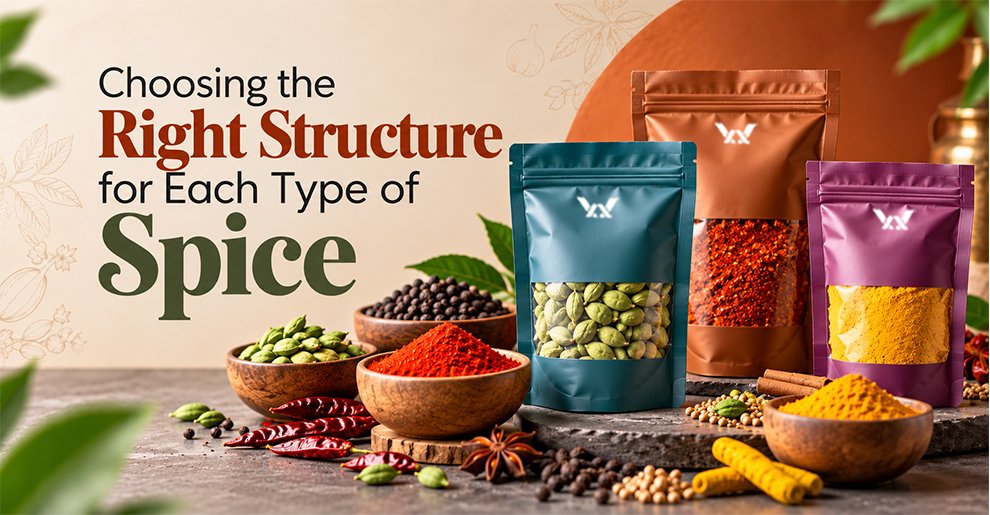
Over-specifying the barrier on a pouch for spices packaging wastes money; under-specifying it risks caking, aroma loss and complaints. The table below is general guidance. Confirm the final structure with your supplier and with shelf-life checks on your own product.
| Product | Main Risk | Commonly Used Structure | Relative Cost |
|---|---|---|---|
| Blended ground masala (garam masala, kitchen king) | Aroma loss, moisture | PET / Met PET / LDPE or PET / Foil / LDPE | Medium to high |
| Red chilli powder | Light fading colour, oil migration | Met PET or foil-based, avoid large windows | Medium to high |
| Turmeric powder | Light fading, moisture | Opaque metallised or foil-based laminate | Medium |
| Whole spices (cloves, cinnamon, cardamom) | Puncture, aroma loss | PET / LDPE or Met PET with a thicker sealant layer | Low to medium |
| Asafoetida (hing) | Very strong odour | High-barrier foil laminate | High |
| Bulk and HoReCa packs (1 kg and above) | Weight, seal stress | Thicker laminate, gusseted format | Medium to high |
For brands that want to reduce plastic or use recyclable structures, see this overview of eco-friendly food packaging options. Sustainable structures can cost more, and their barrier performance must be checked for spices.
Compliance Details That Affect Your Artwork
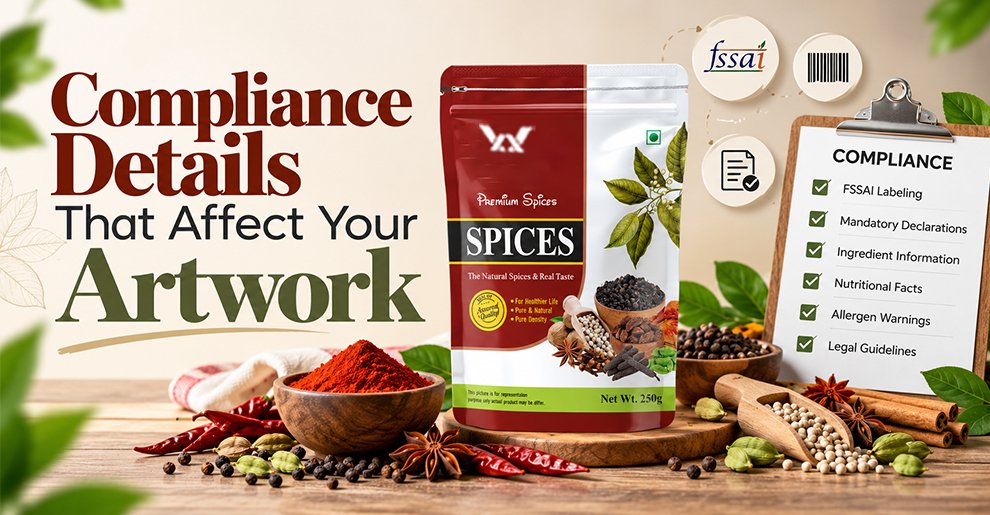
Compliance does not change the per-kg rate, but it affects how much print area you need and whether you will have to reprint. Mistakes here can make cylinders obsolete.
- FSSAI labelling: Packaged spices need mandatory details under the FSSAI labelling regulations, such as product name, ingredients, nutrition information where applicable, the veg symbol, FSSAI logo and licence number, net quantity, date marking and manufacturer details.
- Legal Metrology: Pre-packaged goods also need declarations such as MRP and consumer care details.
- Plastic EPR: Brand owners placing plastic packaging on the Indian market must register on the CPCB’s centralised EPR portal. Since 1 July 2025, packaging is also expected to carry marking details such as the EPR registration number, which can be provided through a printed number, barcode or QR code.
Rules are updated from time to time. Verify current requirements from FSSAI, the Legal Metrology department and the CPCB EPR portal before finalising artwork, and leave space in the design for these elements.
How to Compare Quotes From Pouch Suppliers
Ask every supplier of packing pouches for spices to provide the same information so you can compare like with like:
- Full material structure, with micron for each layer
- Total GSM and pouches per kg
- Rate per kg and equivalent rate per pouch
- Number of cylinders or plates, cost of each, and ownership
- MOQ per design and per order
- Delivery quantity tolerance
- Lead time for the first order and for repeat orders
- Whether the inks and adhesives are suitable for food contact, and what documents or test reports they can share
- Freight, packing and GST, stated separately
- Rate validity period and payment terms
A low per-kg rate on a thicker structure can still cost more per pouch than a higher rate on a thinner, well-designed structure. That is why the per-pouch comparison matters.
Need a quote you can actually compare? Share your pouch size, fill weight, structure and quantity with a specialist masala packing pouch manufacturer and ask for a per-pouch breakdown.
7 Practical Ways to Reduce Packaging Cost
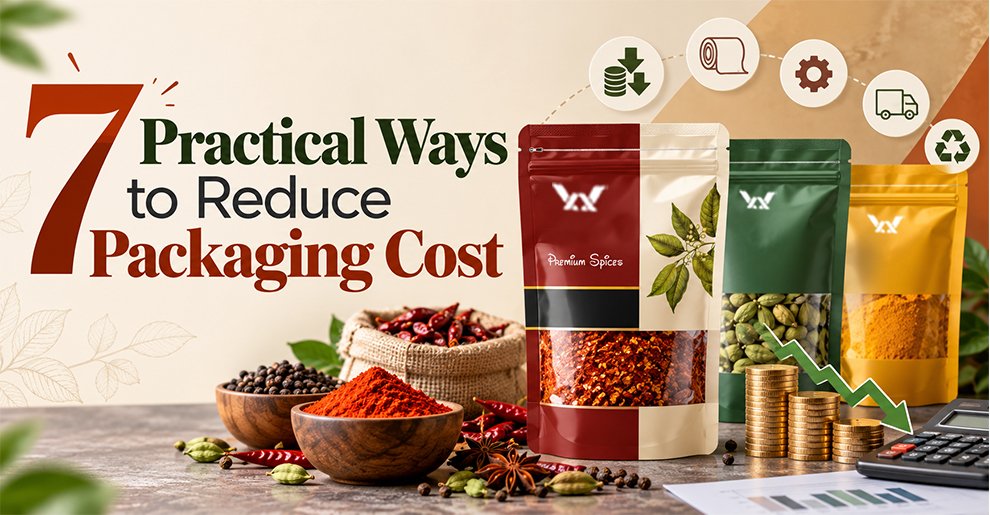
- Standardise pouch sizes across spices so you can order larger runs of fewer formats.
- Design for shared cylinders by keeping common brand elements fixed across SKUs.
- Match barrier to product. A pouch for spices packaging that holds fast-moving whole spices may not need the same structure as a premium garam masala.
- Start digital, scale to rotogravure once a SKU proves its demand.
- Consider roll stock if you use, or plan to buy, an automatic form-fill-seal machine. Printed laminated rolls skip the pouch-making step, which can lower cost at volume.
- Order in sensible batches, not just the cheapest per-unit quantity. Overstock ties up cash, and artwork or regulatory changes can make old stock unusable.
- Get artwork right before printing to avoid paying for a second set of cylinders.
Common Mistakes Masala Brands Make When Ordering Pouches
These errors commonly push up the real cost of packing pouches for spices:
- Comparing per-kg rates directly without checking pouches per kg.
- Choosing the thinnest film to save cost, then facing punctures and leaking seals.
- Ignoring one-time costs when budgeting for a product launch.
- Creating a separate design for every SKU instead of planning a shared cylinder system.
- Adding a large window to chilli or turmeric packs, which exposes the product to light.
- Skipping a physical sample or proof, then discovering colour mismatch after printing.
- Leaving out mandatory label information, which leads to reprints.
Working With a Masala Pouch Manufacturer
The cheapest quote is not always the lowest cost. A manufacturer who helps you choose the right structure, plans cylinders across your range and gives a clear per-pouch breakdown can save more than a small difference in rate.
White Lotus Industries manufactures packing pouches for spices and other food products. If you are planning a new range or reviewing your current packaging cost, you can share your requirements, including spice type, fill weight, preferred pouch style, quantity and design, and request a structured quotation.
Conclusion
The cost of a printed masala packaging pouch is not a single number. It is the result of choices you make about material, size, style, printing method, design and quantity. Once you convert every quote into a cost per usable pouch and include one-time charges, comparing suppliers becomes straightforward.
For most brands, the biggest savings come from planning rather than bargaining: standardise sizes, share cylinders across SKUs, match the barrier to each spice and start with digital printing where volumes are uncertain.
Ready to estimate your packaging cost? Prepare your pouch size, fill weight, spice type and expected quantity, then request a detailed quote from a masala packing pouch manufacturer so you can compare your options with confidence.
Frequently Asked Questions
Q1: What is the price of a printed pouch for masala packing?
The price of a printed pouch for masala packing depends on material structure, size, thickness, pouch style, printing method, colours, quantity and add-ons. Simple three-side seal pouches in high volume cost far less per piece than small runs of zipper stand-up pouches. Ask suppliers for a per-pouch breakdown based on your exact specification.
Q2: Why do pouch manufacturers quote per kg instead of per piece?
Manufacturers buy films and run machines based on weight and length, so per-kg pricing reflects their real costs. To convert it, calculate the pouch weight from its area and the laminate’s GSM, then work out how many pouches make one kilogram. Divide the per-kg rate by that number to get the cost per pouch.
Q3: What is a cylinder charge in pouch printing?
A cylinder charge is the one-time cost of engraving the rotogravure cylinders used to print your design. Each colour usually needs its own cylinder. The cylinders are reused for repeat orders of the same design, so the charge mainly affects the first order. Ask who owns the cylinders and how long the supplier stores them.
Q4: What is the minimum order quantity for printed masala pouches?
Minimum order quantities vary by manufacturer and printing method. Rotogravure printing usually needs larger runs because of cylinder and setup costs, while digital printing allows small quantities with no cylinders. Ask for the MOQ per design, since a multi-SKU range can multiply your total commitment.
Q5: Is digital printing cheaper than rotogravure for spice pouches?
Digital printing is usually cheaper for small runs because there are no cylinders. Rotogravure becomes cheaper per pouch at larger volumes because its running cost is lower. Many brands use digital pouches for launches and trial SKUs, then move proven products to rotogravure.
Q6: Which pouch material is best for chilli powder and turmeric?
Opaque, high-barrier structures such as metallised PET or aluminium foil laminates are commonly used for chilli powder and turmeric because light can fade their colour. Avoid large clear windows on these products. Confirm the final structure with shelf-life checks on your own product and storage conditions.
Q7: Is GST charged on printed spice pouches?
Yes. Plastic packaging pouches under HSN 3923 attract 18% GST. Registered businesses can generally claim input tax credit on the GST paid when the conditions under the CGST Act are met. Confirm the classification and credit eligibility with your tax adviser.
Q8: Do I need EPR registration to sell spices in plastic pouches?
In most cases, yes. Brand owners who place products in plastic packaging on the Indian market are required to register on the CPCB’s centralised EPR portal under the Plastic Waste Management Rules. Packaging marking requirements also apply. Check the current rules on the official CPCB portal.