
Choosing the right flexible packaging supplier is an important decision for any business that sells packaged products. The quality of your packaging affects product protection, shelf life, brand presentation, storage, and transportation. A supplier that understands your requirements can help you maintain consistent packaging quality and avoid unnecessary production delays.
However, selecting a supplier based only on price can create problems later. Differences in material quality, printing accuracy, sealing performance, and delivery schedules can affect your entire packaging operation. This is particularly important when placing bulk packaging orders, where even a small issue can affect a large quantity of products.
Before finalizing an order, businesses should evaluate the supplier’s manufacturing capabilities, material options, quality-control procedures, sample quality, pricing structure, and customer support.
In this guide, we explain seven important factors to consider when choosing a flexible packaging supplier, along with a practical checklist to help you make a more informed purchasing decision.
Why Choosing the Right Flexible Packaging Supplier Matters
Flexible packaging is widely used across food and beverages, pharmaceuticals, personal care, agriculture, pet food, and other industries. Depending on the product, packaging may need to protect against moisture, oxygen, light, contamination, or leakage while maintaining its appearance and functionality.
A suitable supplier helps you select packaging materials and formats according to your product’s requirements, filling process, storage conditions, and distribution needs.
Here are some important reasons to evaluate your supplier carefully.
Consistent packaging quality: Consistent material thickness, printing, dimensions, and sealing help maintain uniformity across production batches.
Product protection: The right laminate structure can provide the barrier properties needed to protect your product during storage and transportation.
Better cost management: Evaluating the complete quotation helps you understand the actual cost of packaging instead of comparing suppliers only by their price per unit.
Reliable production planning: A supplier with suitable production capacity and clear delivery schedules can help you plan inventory and avoid unexpected packaging shortages.
Brand presentation: Accurate printing, suitable finishes, and professional packaging design help your products maintain a consistent appearance across retail and distribution channels.
Long-term business relationships: Working with a supplier that communicates clearly and resolves problems professionally makes repeat orders easier to manage.
For these reasons, selecting a supplier should involve more than comparing prices. Businesses should assess the complete package of quality, service, production capabilities, and commercial terms.
7 Factors to Check Before Placing a Bulk Packaging Order
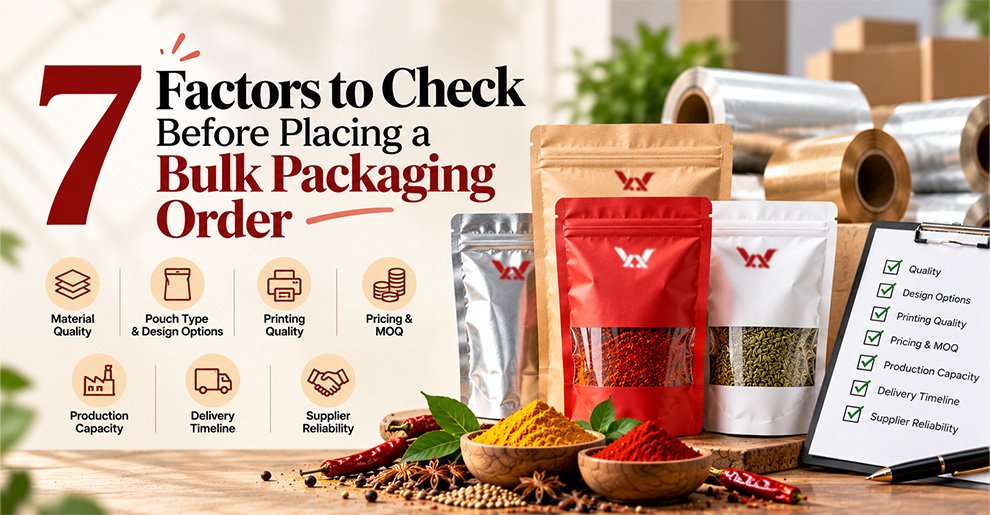
Before placing a large order, evaluate the following seven factors to understand whether a supplier can meet your business requirements.
1. Check Manufacturing Experience and Capabilities
The first step is to understand the supplier’s manufacturing experience and whether its capabilities match your packaging requirements.
Different products require different packaging formats, material combinations, printing methods, and functional features. A supplier experienced in one type of packaging may not necessarily be the right choice for every application.
Start by checking the following:
- Industry experience: Find out whether the supplier has experience with products similar to yours.
- Packaging formats: Check whether it manufactures the required pouch styles, laminated films, or roll-form packaging.
- Customization options: Confirm the availability of custom sizes, shapes, printing, finishes, and closures.
- Production capacity: Determine whether the supplier can handle your initial order and anticipated repeat orders.
- Technical support: Ask whether the team can help you identify suitable materials and packaging structures.
For example, a company packing spices may need strong aroma retention and moisture protection, while a beverage brand may require a leak-resistant pouch with a suitable spout. A dry fruit business may prioritize moisture and oxygen barriers to help preserve product quality.
You should also check whether the supplier can accommodate future changes in order volume, packaging dimensions, or artwork.
Review its product range before requesting a quotation. Exploring options such as stand-up pouches can help you understand which formats may suit your product and retail requirements.
A capable flexible packaging manufacturer should be able to explain its available solutions and help you determine which specifications need to be finalized before production.
2. Evaluate Material Quality and Product Compatibility
Material selection is one of the most important steps when evaluating a flexible packaging supplier. The right packaging structure depends on the product being packed, the required shelf life, the filling method, and the conditions in which the product will be stored and transported.
A material that works well for dry snacks may not be appropriate for liquid products or moisture-sensitive powders.
Before confirming an order, discuss the following factors with the supplier.
Material structure: Ask which layers and materials are suitable for your product. Different combinations may provide different levels of strength, flexibility, printability, and barrier protection.
Thickness: Confirm the required thickness according to product weight, handling conditions, and packaging performance requirements.
Barrier properties: Determine whether the packaging needs protection against moisture, oxygen, light, or product-specific environmental factors.
Sealing performance: The packaging should form reliable seals under the intended filling and sealing conditions.
Product compatibility: Check whether the proposed materials are appropriate for the product’s formulation and intended contact with the packaging.
Storage and transportation: Consider temperature, humidity, stacking, transportation distance, and expected storage duration.
For food products, businesses should verify the suitability of food-contact materials and any applicable regulatory requirements. Pharmaceutical and other regulated products may require additional documentation and compliance checks.
For instance, a dry fruit brand may need a laminate structure that helps limit moisture and oxygen exposure. A powdered food product may require moisture protection and reliable seals to reduce the risk of contamination.
Businesses looking for product-specific options can explore multilayer flexible packaging to understand how different material layers serve different packaging functions.
Do not choose a material simply because it is cheaper or thicker. The objective is to identify a structure that meets your product’s performance requirements without unnecessary material costs.
3. Review Quality-Control Processes and Certifications
Quality control is another essential consideration when selecting a flexible packaging supplier.
Packaging defects can lead to leaking pouches, inconsistent dimensions, poor printing, weak seals, or material damage. During bulk production, such problems can affect product presentation and create avoidable waste.
Before placing your order, ask the supplier how it monitors quality during manufacturing.
Important points to evaluate include:
- Incoming raw-material inspection.
- Laminate and material thickness checks.
- Printing quality and colour consistency.
- Pouch dimensions and structural accuracy.
- Seal integrity and leak testing, where applicable.
- Batch identification and traceability.
- Procedures for identifying and addressing defective products.
- Availability of relevant quality and compliance documentation.
You should also review the supplier’s certifications and confirm that they are current, applicable to the facility and product concerned, and issued by the relevant certification body.
A certification should not be accepted as a substitute for checking the actual requirements of your packaging application. For food, pharmaceutical, and other regulated uses, verify the specific documentation and testing required for your product and destination market.
If your business exports products, confirm whether the packaging specifications and supporting documents meet the requirements of your target market.
For additional confidence, ask for relevant test reports, technical specifications, and quality documents before approving production.
A supplier with documented quality-control procedures can help your business establish clearer acceptance criteria for every order. You can also review its stated quality-assurance processes to understand the checks it performs and the standards it follows.
4. Request Samples Before Confirming Bulk Production
Requesting samples is a practical way to evaluate packaging before committing to a large order.
Product descriptions and quotations can explain the proposed specifications, but they cannot fully demonstrate how the packaging will perform in your actual operation.
Whenever possible, request samples that closely match the material structure, dimensions, printing, finish, and functional features you intend to order.
Evaluate the following points:
Appearance and printing: Check whether the artwork, colours, text, logos, and other design elements match your approved requirements.
Dimensions: Verify the pouch width, length, gusset, opening, and other measurements relevant to your filling process.
Material feel and strength: Examine whether the material is appropriate for the product’s weight and handling conditions.
Sealing performance: Confirm that the packaging seals reliably under the intended operating conditions.
Functional features: Test zippers, spouts, tear notches, handles, and other features included in the design.
Machine compatibility: If you use automated packaging equipment, check whether the packaging format and specifications are suitable for your machine.
For roll-form packaging, it is particularly important to confirm compatibility with the filling and sealing equipment. Film dimensions, material properties, and sealing behaviour can influence machine performance.
For pouches containing liquids, powders, or products sensitive to environmental exposure, conduct the relevant product-specific checks before approving mass production.
Once the sample is approved, document the final specifications and retain the approved reference where practical. This gives both parties a clear standard for comparing the finished bulk order.
Avoid approving production based only on a general sample if the final order will use a different material structure or design.
5. Compare Quotations Beyond the Price Per Unit
Price is an important factor when purchasing packaging in bulk, but the lowest quotation does not always represent the best overall value.
Two suppliers may quote different prices because they are offering different material structures, thicknesses, printing specifications, order quantities, or delivery terms.
To make a fair comparison, request quotations based on the same packaging specifications.
Check the following cost components:
- Raw-material structure and thickness.
- Pouch dimensions and design complexity.
- Printing method, number of colours, and artwork requirements.
- Special features such as zippers, spouts, or tear notches.
- Printing cylinder, plate, tooling, or setup charges, where applicable.
- Minimum order quantity and quantity-based pricing.
- Packaging, transportation, taxes, and other applicable charges.
- Payment terms and quotation validity.
- Costs associated with changes to approved artwork or specifications.
For example, Supplier A may offer a lower price per pouch but use a different material structure or exclude certain setup charges. Supplier B may offer a higher unit price while including specifications that better match your requirements.
The correct comparison is therefore between quotations offering equivalent packaging specifications and commercial terms.
It is also useful to estimate the total cost of ownership. Packaging that performs reliably may help reduce avoidable waste, rejected products, filling-line interruptions, and replacement costs.
Before making a decision, clarify whether the quoted price applies to the exact quantity you intend to order. Ask whether the price changes for larger volumes and whether repeat orders will follow the same commercial terms.
For more information about the factors that influence packaging expenses, read our guide on custom packaging cost factors.
A transparent quotation makes it easier to compare suppliers, control purchasing costs, and avoid unexpected expenses after the order is confirmed.
6. Confirm Minimum Order Quantity and Production Lead Time
Minimum order quantity (MOQ) and production lead time are especially important when placing bulk packaging orders.
A supplier may offer suitable materials and competitive pricing but still be unsuitable if its minimum quantity exceeds your requirements or its delivery schedule does not fit your production plan.
Before confirming the order, clarify the following details.
Minimum order quantity: Ask about the minimum quantity for each pouch size, design, material structure, or artwork variation.
Production lead time: Confirm the expected time required for material procurement, printing, lamination, pouch conversion, inspection, and dispatch, as applicable.
Artwork approval: Determine whether production begins only after the final design and specifications have been approved.
Order scheduling: Ask whether the supplier can accommodate planned repeat orders and seasonal demand.
Delivery arrangements: Confirm the shipping method, delivery location, packaging of finished goods, and responsibility for transportation.
Reorder planning: Discuss how much notice is required for repeat orders and whether the supplier can work with your expected purchasing schedule.
Lead times may vary according to material availability, order quantity, printing requirements, production schedules, and the complexity of the packaging design. Request a realistic timeline for your specific order instead of relying on a general estimate.
It is also worth clarifying how delays will be communicated and what happens if the delivery schedule changes.
For businesses with seasonal demand, such as festive foods, promotional products, or agricultural goods, timely packaging availability can be particularly important.
A clear production and delivery plan helps you coordinate inventory, avoid last-minute purchasing, and maintain a more predictable packaging supply.
7. Check Communication, Documentation, and After-Sales Support
A good supplier relationship depends on more than manufacturing capability. Clear communication and proper documentation are equally important, especially when dealing with customized packaging and recurring bulk orders.
Before selecting a supplier, assess how effectively it handles enquiries, technical questions, design approvals, order updates, and quality-related concerns.
Here are some important things to check.
Response time: Does the supplier respond to questions and provide clear information about your requirements?
Technical communication: Can its team explain material choices, dimensions, printing specifications, and other technical details in understandable terms?
Written confirmation: Are specifications, prices, order quantities, delivery schedules, and payment terms documented before production?
Artwork approval: Is there a clear process for reviewing and approving final artwork?
Order tracking: Will you receive updates about production progress and dispatch?
Complaint handling: Is there a documented process for reporting defective packaging or discrepancies?
After-sales support: Can the supplier investigate issues and explain the next steps if the delivered packaging does not match the agreed specifications?
Documentation is particularly important for customized products because even a small misunderstanding about material layers, pouch dimensions, or artwork can affect the finished order.
Maintain copies of approved artwork, technical specifications, quotations, purchase orders, sample approvals, and quality documents. These records can simplify repeat purchases and help resolve disagreements.
You should also clarify the supplier’s terms for handling defects, replacements, or other quality-related concerns before placing the order.
A supplier that communicates consistently and documents its commitments can make procurement easier to manage and support a more dependable long-term business relationship.
Flexible Packaging Supplier Evaluation Checklist
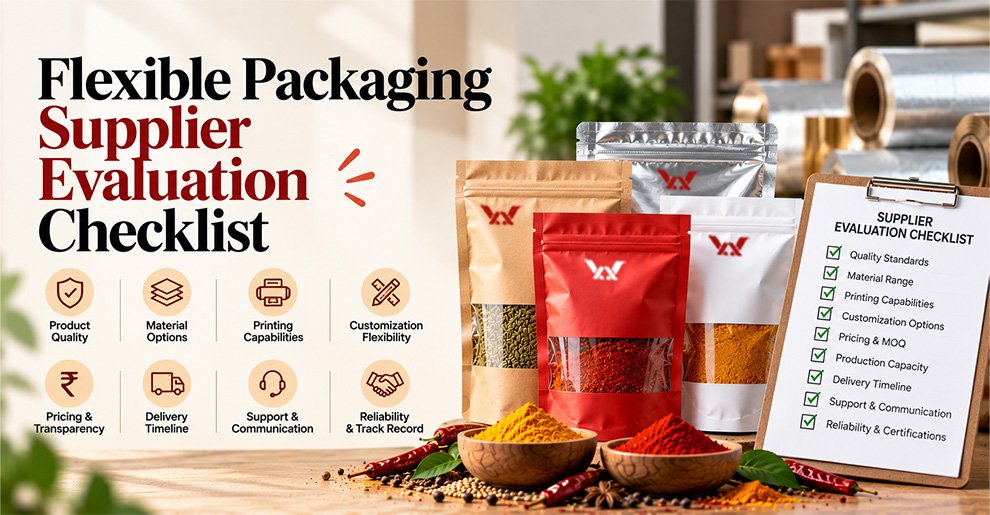
Before finalizing a supplier, use this checklist to compare your shortlisted options. Evaluating each supplier against the same criteria helps you make a more objective decision.
| Evaluation Factor | What to Verify |
|---|---|
| Manufacturing Experience | Relevant experience and production capabilities. |
| Packaging Formats | Required pouch, laminate, or roll-form options. |
| Material Specifications | Suitable material structure and thickness. |
| Product Compatibility | Appropriate packaging for the product and filling process. |
| Quality Control | Documented inspections and relevant testing. |
| Certifications | Current and applicable certifications and compliance documents. |
| Sample Approval | Samples checked and final specifications approved. |
| Printing Quality | Artwork, colours, text, and finish verified. |
| Quotation | Comparable specifications and complete commercial terms. |
| Minimum Order Quantity | MOQ confirmed for each required design. |
| Production Lead Time | Timeline and delivery expectations agreed. |
| Communication | Clear point of contact and written confirmations. |
| Defect Handling | Quality complaint and replacement terms clarified. |
| Future Orders | Repeat-order requirements and purchasing plans discussed. |
Do not rely on a single factor to make your decision. A supplier that offers the lowest price may not provide the material performance, delivery reliability, or support your business needs.
Instead, compare the suppliers against your priorities and document any unresolved questions before approving the purchase order.
For a large or technically demanding order, consider agreeing on written quality acceptance criteria and completing appropriate production or performance checks before committing to the full quantity.
Why Consider White Lotus Industries for Flexible Packaging?
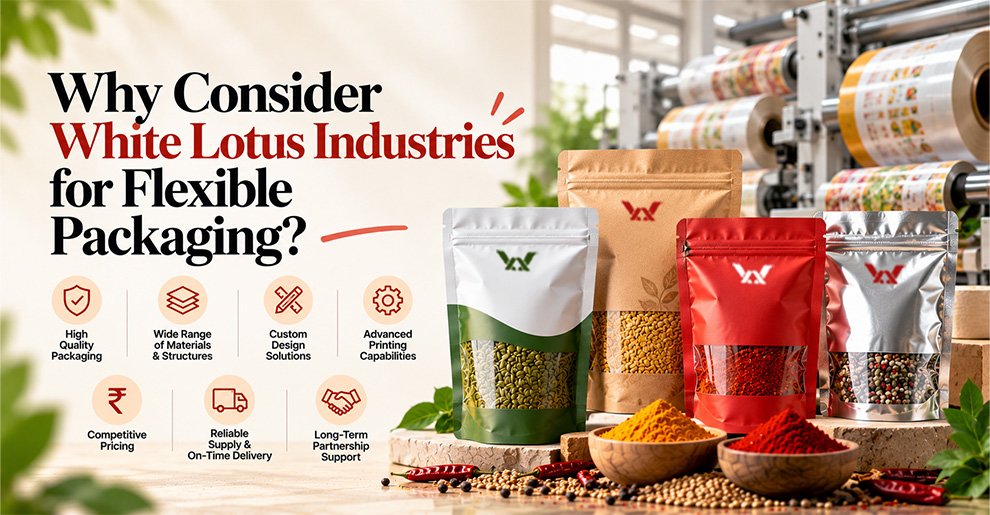
When evaluating a flexible packaging supplier, businesses should look for a company that understands material selection, packaging customization, manufacturing quality, and the requirements of different industries.
White Lotus Industries provides flexible packaging solutions for businesses looking for customized pouches and laminated packaging materials. Its product range includes multiple pouch formats and packaging options designed for different product and operational requirements.
When reviewing a potential packaging partner, consider the following capabilities.
Customized packaging solutions: Packaging dimensions, material structures, printing, and functional features should be selected according to the product’s needs.
Multiple pouch formats: Different products may require stand-up pouches, flat-bottom pouches, centre-seal pouches, spout pouches, or other formats.
Material and barrier options: The packaging structure should be chosen according to the required product protection, shelf life, and storage conditions.
Quality assurance: Businesses should review the supplier’s quality-control processes and verify the certifications and documentation relevant to their application.
Bulk-order planning: Clear communication about quantities, specifications, production timelines, and delivery requirements helps businesses prepare for repeat purchases.
Before requesting a quotation, prepare your product details, estimated order quantity, pouch dimensions, material requirements, artwork, and any relevant technical or regulatory specifications. This information helps the supplier understand your needs and provide a more relevant proposal.
You can also review the available product range to identify packaging formats that may suit your business.
The goal is to establish a packaging solution that balances product protection, functionality, presentation, and purchasing costs rather than selecting materials based on price alone.
Conclusion
Choosing the right flexible packaging supplier requires careful evaluation of manufacturing capabilities, material quality, certifications, sample performance, pricing, production timelines, and customer support.
Before placing a bulk order, make sure the supplier understands your product requirements and can provide packaging that meets your agreed specifications. Request samples, compare quotations on an equivalent basis, verify relevant documentation, and confirm delivery schedules in writing.
A structured evaluation process can help businesses reduce purchasing risks, improve packaging consistency, and develop stronger supplier relationships over time.
Whether you are launching a new product or planning repeat bulk packaging orders, taking the time to evaluate your supplier can support better purchasing decisions and smoother production planning.
Start with a clear list of requirements, compare suitable suppliers carefully, and approve the final packaging specifications before production begins.
FAQs
Q1. How do I choose the right flexible packaging supplier?
To choose the right flexible packaging supplier, evaluate its manufacturing capabilities, material quality, customization options, quality-control procedures, pricing, and delivery timelines. Request samples, verify relevant certifications, and confirm that the supplier can meet your product specifications and bulk order requirements before making a decision.
Q2. What factors should I consider before placing a bulk packaging order?
Before placing a bulk packaging order, check the material structure, packaging dimensions, printing quality, minimum order quantity (MOQ), production lead time, and total cost. You should also approve a sample, confirm delivery schedules, and document the final specifications to reduce the risk of errors during production.
Q3. Why is material quality important when selecting a flexible packaging supplier?
Material quality affects product protection, packaging strength, sealing performance, and shelf life. The right material depends on the product being packed, its storage conditions, and the required barrier properties. A reliable supplier should explain the available materials and help you identify a suitable structure for your application.
Q4. Should I request samples before ordering flexible packaging in bulk?
Yes, requesting samples allows you to evaluate the packaging before committing to a large order. Check the dimensions, material quality, printing, sealing performance, and functional features. If you use automated filling equipment, test the sample for machine compatibility. Approve the final specifications in writing before production begins.
Q5. How can I compare quotations from different flexible packaging manufacturers?
Compare quotations using identical packaging specifications, including material structure, thickness, dimensions, printing requirements, and order quantity. Consider setup charges, tooling costs, transportation, taxes, and payment terms where applicable. Comparing the total cost for equivalent specifications helps you identify the most suitable option rather than choosing solely by the lowest unit price.