
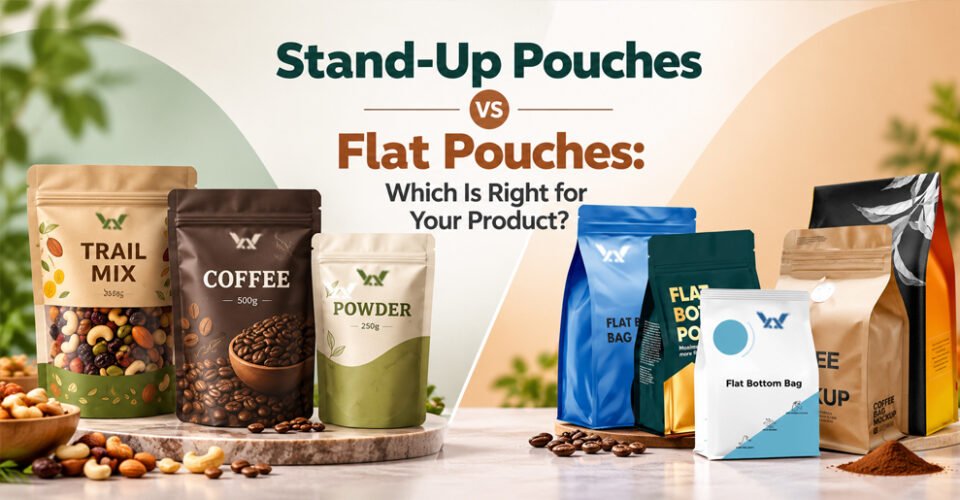
Choosing the right packaging format can have a major impact on product protection, shelf appeal, storage, transportation, and customer convenience. Two popular flexible packaging options used by food, FMCG, personal care, agriculture, and other industries are stand-up pouches and flat pouches.
But which one is better for your product?
When comparing Stand-Up Pouches vs Flat Pouches, there is no single answer that works for every business. The right choice depends on your product type, required capacity, shelf-life requirements, branding needs, filling process, storage conditions, and packaging budget.
Stand-up pouches are known for their upright display, strong shelf presence, and convenient features such as zippers and spouts. Flat pouches, on the other hand, offer a compact, lightweight structure that can be particularly useful for single-use products, samples, powders, and products where storage efficiency is important.
In this guide, we will explain the difference between stand-up and flat pouches, compare their features, discuss their costs, and help you decide which flexible packaging pouch is right for your product.
What Are Stand-Up Pouches?
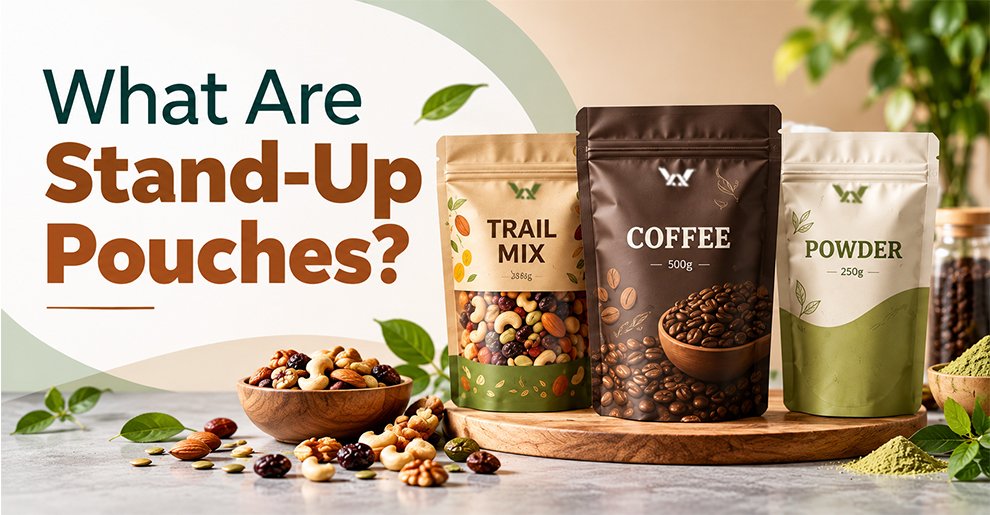
A stand-up pouch is a flexible packaging format designed with a bottom gusset that allows the pouch to stand upright when filled. This structure provides stability while also creating a larger visible area for product branding.
Stand-up pouches have become popular because they combine functionality, convenience, lightweight construction, and attractive shelf presentation.
They can be manufactured in different sizes, material structures, finishes, and printing options. Depending on the product, they can also include features such as:
- Resealable zippers
- Tear notches
- Spouts
- Handles
- Transparent windows
- Different matte or glossy finishes
- High-barrier laminate structures
Stand-up pouches are commonly used for snacks, dry fruits, pet food, spices, tea, coffee, sauces, cleaning products, and many other products.
For example, White Lotus Industries manufactures stand-up pouches designed for different solid and liquid applications, with options focused on shelf visibility, resealability, and product protection.
A well-designed stand-up pouch can therefore do more than hold a product—it can also improve customer convenience and strengthen the visual identity of a brand.
What Are Flat Pouches?
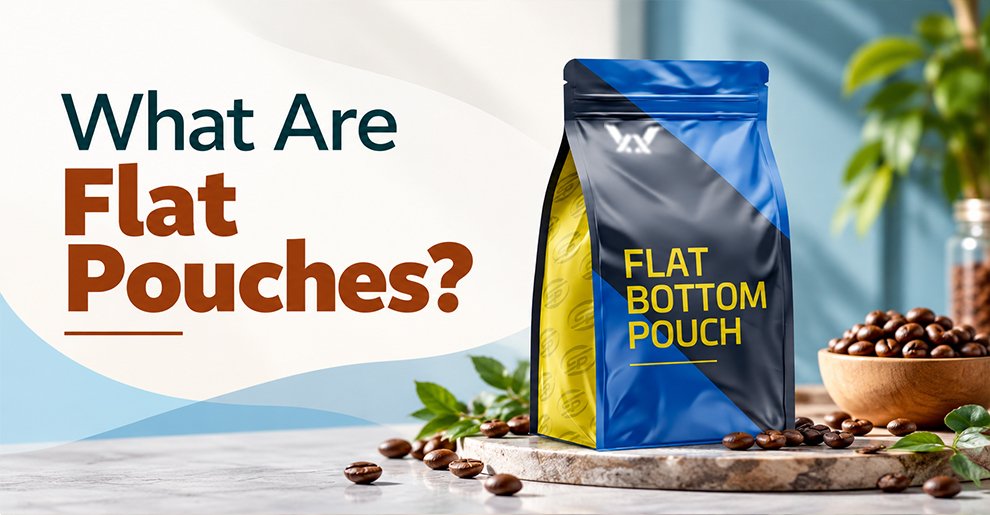
Flat pouches are flexible packaging formats that maintain a relatively flat profile rather than standing upright on their own.
They are commonly produced using laminated flexible packaging materials that provide protection against factors such as moisture, oxygen, light, dust, and contamination, depending on the selected structure.
Flat pouch formats can include three-side seal pouches and other compact flexible packaging configurations.
Their flat construction makes them particularly useful when products need to be stored, transported, or displayed in a space-efficient format.
Common applications include:
- Spices and powders
- Single-serve food products
- Samples
- Pharmaceutical products
- Personal care products
- Small quantities of dry products
- Sachets and promotional packs
One major advantage of flat pouches is their simple and efficient structure. White Lotus Industries offers three-side seal pouch solutions that provide a compact flat design, strong perimeter sealing, and efficient material usage.
For brands looking for a simple packaging solution without the need for an upright shelf display, flat pouches can be a practical choice.
Stand-Up Pouches vs Flat Pouches: Key Differences
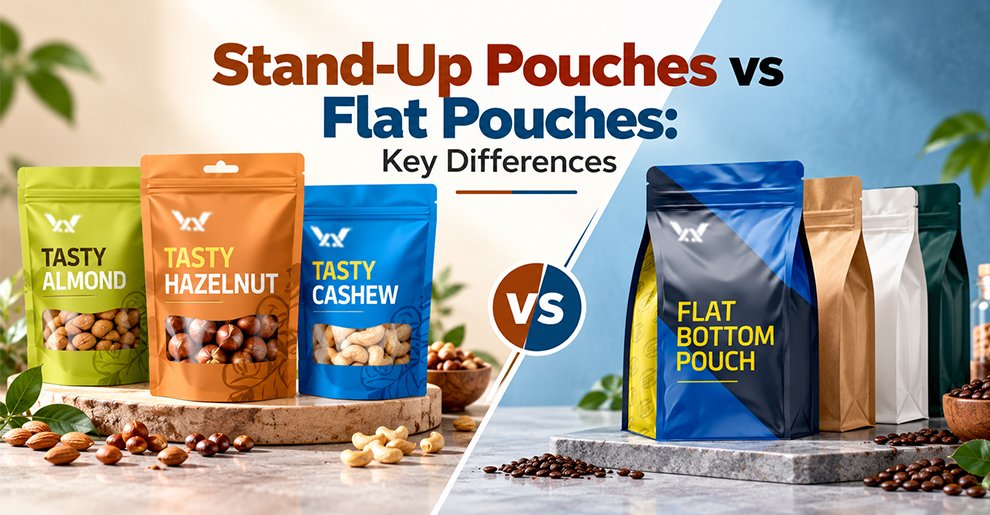
Understanding the key differences is important before selecting a packaging format.
1. Structure and Stability
The most obvious difference between the two formats is their structure.
Stand-up pouches include a bottom gusset that allows them to remain upright after filling. This makes them suitable for retail shelves and products that benefit from vertical presentation.
Flat pouches have a simpler flat construction and generally require support or a horizontal arrangement for display.
Best choice for upright stability: Stand-up pouches.
2. Shelf Visibility
Shelf visibility is an important consideration for consumer products.
A stand-up pouch naturally faces the customer when placed on a retail shelf. This provides a larger visible branding area and can make the product easier to notice.
Flat pouches can still provide excellent printing and branding space, but their presentation depends more on how they are arranged on the shelf.
Best choice for shelf presentation: Stand-up pouches.
3. Storage and Transportation
Both packaging formats are lightweight compared with many rigid packaging alternatives.
Flat pouches have a particularly compact profile before filling, which can help businesses optimize storage and transportation.
Stand-up pouches also offer efficient transportation because flexible packaging generally requires less space and weight than many rigid alternatives.
The final efficiency depends on pouch dimensions, material thickness, product volume, and packaging configuration.
4. Product Capacity
Stand-up pouches can accommodate a wide range of product quantities because their bottom gusset creates additional volume.
They are especially useful for products sold in medium or larger quantities.
Flat pouches are generally more suitable for smaller quantities, samples, single servings, and products that do not require a large three-dimensional structure.
5. Product Protection
Both formats can provide strong product protection when the correct packaging material and laminate structure are selected.
For products sensitive to moisture, oxygen, light, or aroma, the material structure is often more important than whether the pouch is simply flat or stand-up.
For this reason, brands should consider the product’s shelf-life requirements before selecting packaging material.
Choosing the right flexible packaging material can help create the required level of barrier protection while maintaining the desired pouch format.
6. Convenience
Stand-up pouches can be customized with features such as zippers, tear notches, and spouts.
These features can make them convenient for products that are used multiple times.
Flat pouches are often simpler to open and use and can work particularly well for single-use products.
7. Branding and Printing
Both stand-up and flat pouches provide excellent opportunities for custom printing.
Brands can use:
- High-quality graphics
- Product photography
- Brand colours
- Logos
- Product information
- Usage instructions
- Regulatory information
Stand-up pouches can provide strong shelf impact because their upright structure creates an attractive retail presentation.
Flat pouches, however, can provide a large flat printing surface that works well for compact packaging and sachet-style products.
8. Customization Options
Modern pouch packaging can be customized according to product requirements.
Depending on the format, businesses can choose:
- Custom pouch dimensions
- Different laminate structures
- Matte or glossy finishes
- Transparent windows
- Tear notches
- Zippers
- Spouts
- Handles
- Custom printing
The best configuration depends on the product, filling process, target market, and customer usage.
9. Packaging Cost
Packaging cost depends on several factors rather than pouch shape alone.
Material selection, pouch size, thickness, printing method, order quantity, additional features, and production requirements can all influence the final pouch packaging cost.
Simple flat pouches may be more economical for certain applications because of their straightforward structure and lower material usage.
Stand-up pouches may cost more when additional gussets, zippers, spouts, or premium materials are required.
Therefore, businesses should compare the total value and performance rather than choosing packaging based only on the lowest initial price.
Stand-Up Pouches vs Flat Pouches: Comparison Table
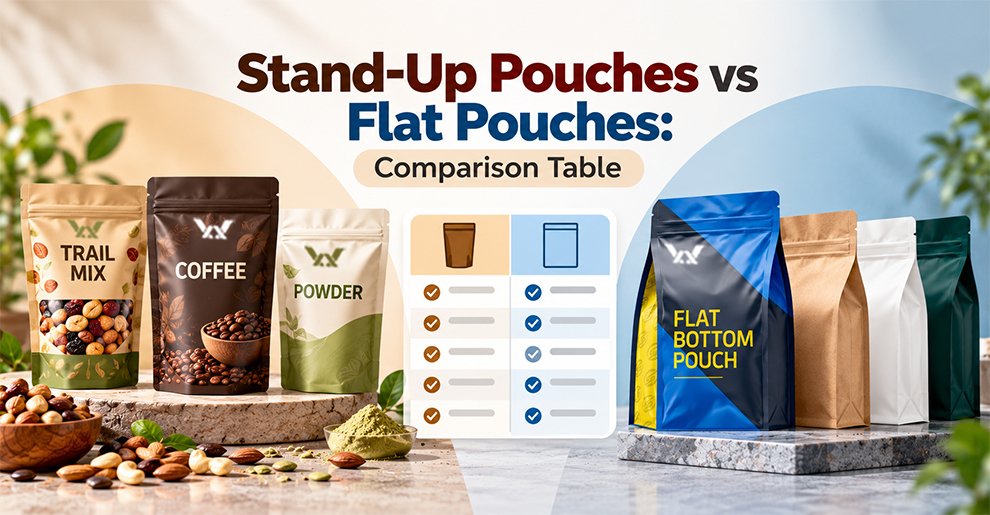
| Feature | Stand-Up Pouches | Flat Pouches |
|---|---|---|
| Structure | Bottom gusset allows upright standing | Flat flexible structure |
| Shelf Display | Excellent | Good |
| Shelf Visibility | High | Moderate to high |
| Storage | Efficient | Highly space-efficient |
| Transportation | Lightweight and efficient | Lightweight and compact |
| Product Capacity | Small to large | Small to medium, depending on design |
| Resealable Options | Zipper and other options available | Available depending on design |
| Spout Option | Available | Available in selected formats |
| Branding | Excellent | Excellent |
| Single-Use Products | Suitable | Highly suitable |
| Premium Retail Products | Highly suitable | Suitable |
| Liquids | Suitable with appropriate structure and spout | Suitable with appropriate design |
| Powders | Suitable | Highly suitable |
| Samples | Suitable | Excellent |
| Shelf Stability | Excellent | Limited without support |
| Customization | High | High |
Advantages of Stand-Up Pouches
Stand-up pouches offer several advantages for brands looking for attractive and functional packaging.
Better Shelf Visibility
The upright structure makes products easier to see on retail shelves.
This can help brands create stronger visual impact and provide more space for important branding elements.
Convenient and Resealable Options
Stand-up pouches can include zipper closures, allowing consumers to open and reseal the package multiple times.
This is particularly useful for snacks, dry fruits, tea, coffee, pet food, and other products that are consumed over multiple occasions.
Suitable for Different Product Categories
Stand-up pouches can be used for both solid and liquid products.
They are commonly used for:
- Snacks
- Dry fruits
- Tea
- Coffee
- Spices
- Pet food
- Cleaning products
- Sauces
- Beverages
- Agricultural products
Strong Branding Opportunities
The pouch provides a large printable surface that brands can use to communicate their identity and product benefits.
High-quality printing, premium finishes, windows, and custom shapes can further differentiate products from competitors.
Advantages of Flat Pouches
Flat pouches also offer several benefits, particularly for products where compactness and simplicity are priorities.
Lightweight and Space-Saving
Their flat structure makes them easy to store and transport.
They can be especially useful for businesses that need to package large quantities of small or single-use products.
Easy to Store and Transport
Flat pouches can be stacked efficiently, helping businesses optimize warehouse and transportation space.
Their lightweight construction can also support efficient logistics.
Suitable for Single-Use Products
Flat pouches are an excellent option for products sold in small quantities or intended for one-time use.
Examples include:
- Samples
- Spices
- Powder products
- Pharmaceutical products
- Personal care samples
- Single-serve food products
Simple and Practical Packaging
For products that do not need resealing or upright shelf presentation, a flat pouch can provide a straightforward packaging solution.
Stand-Up Pouches vs Flat Pouches: Which Is More Cost-Effective?
When comparing Stand-Up Pouches vs Flat Pouches, cost should be evaluated based on the complete packaging requirement rather than only the pouch format.
Flat pouches may be more cost-effective for simple, lightweight, single-use applications.
Stand-up pouches may provide better overall value for products that need stronger shelf presentation, resealability, greater capacity, or convenient storage.
Factors That Affect Pouch Packaging Cost
Several factors can affect the final cost of custom pouch packaging:
- Packaging material
- Material thickness
- Pouch size
- Pouch structure
- Printing requirements
- Number of colours
- Finishing options
- Zipper or spout
- Order quantity
- Special barrier requirements
- Custom shape or design
- Production specifications
How Order Quantity Influences Cost
Order quantity can have a significant effect on the per-unit packaging cost.
Larger production quantities can often provide better economies of scale, while smaller quantities may have a higher cost per pouch because setup and production expenses are distributed across fewer units.
Businesses should therefore discuss their expected order volume with their packaging manufacturer before finalizing the pouch format.
How Material and Features Affect Pricing
A basic flat pouch with a simple material structure may have a lower cost than a highly customized stand-up pouch containing a zipper, spout, premium laminate, and special finishing.
However, additional features should be selected based on actual product and consumer requirements rather than simply trying to minimize packaging cost.
The goal should be to achieve the right balance between packaging price, product protection, convenience, and brand presentation.
How to Choose Between Stand-Up Pouches and Flat Pouches?
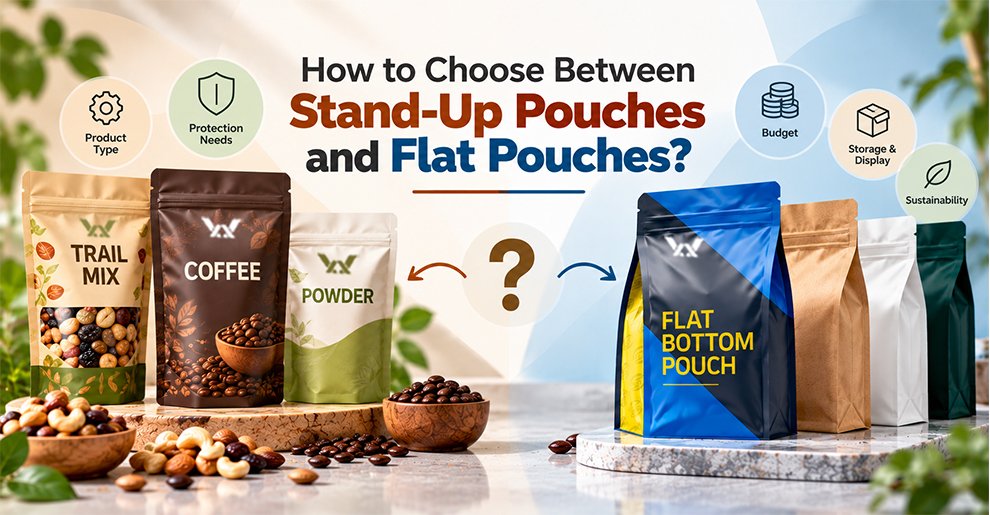
The right pouch depends on your product and business requirements.
Consider Your Product Type
Start by identifying whether your product is a solid, powder, liquid, semi-liquid, or granular product.
Snacks, dry fruits, pet food, and similar products can work well with stand-up formats, while spices, samples, and single-use products can often work effectively with flat pouches.
Consider Product Weight and Volume
Larger or heavier products may require a pouch structure with stronger support and better capacity.
Stand-up or gusseted structures can be suitable when additional volume and stability are required.
Consider Barrier and Shelf-Life Requirements
If your product is sensitive to moisture, oxygen, light, or contamination, select a material structure that provides the appropriate barrier properties.
The pouch format alone does not determine product protection. The material combination, thickness, sealing quality, and overall construction are equally important.
Consider Customer Convenience
Think about how customers will use your product.
If customers need to open and close the package repeatedly, a zipper can be useful.
For liquid products, a spout may improve dispensing.
For single-use products, a simple flat pouch may be more practical.
Consider Shelf Presentation
If your product will be sold primarily through retail stores, shelf visibility may be a major consideration.
Stand-up pouches can provide excellent upright presentation and help products occupy a more visible position on shelves.
Consider Storage and Transportation
Businesses should also evaluate warehouse requirements and transportation conditions.
Both pouch types are lightweight, but the final storage efficiency will depend on pouch dimensions, product quantity, carton configuration, and shipping requirements.
Consider Your Packaging Budget
Finally, compare the total cost against the value the packaging provides.
The cheapest pouch is not always the most cost-effective choice. A slightly higher packaging investment may be worthwhile if it improves shelf appeal, product protection, customer convenience, or brand perception.
Why Choose White Lotus Industries for Custom Pouch Packaging?
Selecting the right packaging manufacturer is just as important as choosing the right pouch format.
White Lotus Industries provides customized flexible packaging solutions designed around different product, branding, and performance requirements.
The company offers multiple pouch formats, including stand-up pouches, flat-bottom pouches, three-side seal pouches, zipper lock pouches, spout pouches, gusseted pouches, and other customized formats.
For brands comparing Stand-Up Pouches vs Flat Pouches, having access to multiple pouch structures can make the selection process easier because the packaging can be matched to the actual product requirements.
White Lotus Industries also focuses on customized packaging solutions, allowing businesses to consider factors such as material selection, structural design, printing, finishing, pouch size, and functional features.
For example, brands can explore the stand-up pouch packaging solutions available from the manufacturer when shelf visibility and upright presentation are important.
Businesses looking for a more premium upright structure can also explore flat-bottom pouches, which provide a stable three-dimensional format and strong shelf presence.
The company also provides flexible packaging solutions across industries including food and beverages, FMCG, personal care, pharmaceuticals and nutraceuticals, agriculture, and industrial products.
This makes White Lotus Industries a suitable option for businesses looking for customized pouch packaging rather than a one-size-fits-all solution.
Before placing an order, brands should discuss their product characteristics, required shelf life, pouch dimensions, expected quantity, printing requirements, and desired features with the packaging manufacturer.
White Lotus Industries can then help businesses evaluate suitable pouch structures and packaging specifications based on their application.
Conclusion
When comparing Stand-Up Pouches vs Flat Pouches, the best option depends on what your product actually needs.
Stand-up pouches are an excellent choice when shelf visibility, upright stability, resealability, convenience, and strong branding are important. They work particularly well for snacks, dry fruits, pet food, tea, coffee, spices, sauces, and many other products.
Flat pouches are a practical choice when compact storage, lightweight construction, simple packaging, and single-use applications are the priority. They can be particularly useful for samples, spices, powders, pharmaceutical products, and other small-quantity products.
There is no universal winner between the two.
The right choice should consider your product type, product quantity, shelf-life requirements, material structure, customer usage, transportation, branding requirements, and packaging budget.
If you are unsure which pouch format is best for your product, working with an experienced flexible packaging manufacturer can help you select the right combination of pouch design, packaging material, barrier properties, printing, and functional features.
With the right packaging structure, your pouch can do more than protect the product—it can improve convenience, strengthen your brand, and create a better experience for your customers.
FAQs
Q1. What is the difference between stand-up pouches and flat pouches?
Stand-up pouches have a bottom gusset that allows them to stand upright when filled, while flat pouches have a compact, flat structure. Stand-up pouches are generally preferred for shelf display and resealable products, while flat pouches are commonly used for single-serve products, samples, powders, and compact packaging.
Q2. Are stand-up pouches better than flat pouches?
Neither format is universally better. Stand-up pouches are a better choice when shelf visibility, upright stability, larger capacity, and resealability are important. Flat pouches can be better when lightweight construction, compact storage, and single-use packaging are the priorities.
Q3. Which is more cost-effective: stand-up pouches or flat pouches?
The cost depends on factors such as material, pouch size, thickness, printing, order quantity, and additional features. Simple flat pouches can be more economical for certain applications, while stand-up pouches may provide better value when features such as zippers, gussets, or spouts are required.
Q4. What products are suitable for stand-up pouches?
Stand-up pouches are commonly used for snacks, dry fruits, coffee, tea, pet food, spices, sauces, beverages, cleaning products, and other food and FMCG products. They can be customized with features such as zippers and spouts depending on the application.
Q5. What products are suitable for flat pouches?
Flat pouches are suitable for products such as spices, powders, samples, single-serve foods, pharmaceutical products, personal care products, and other products that require compact packaging.