
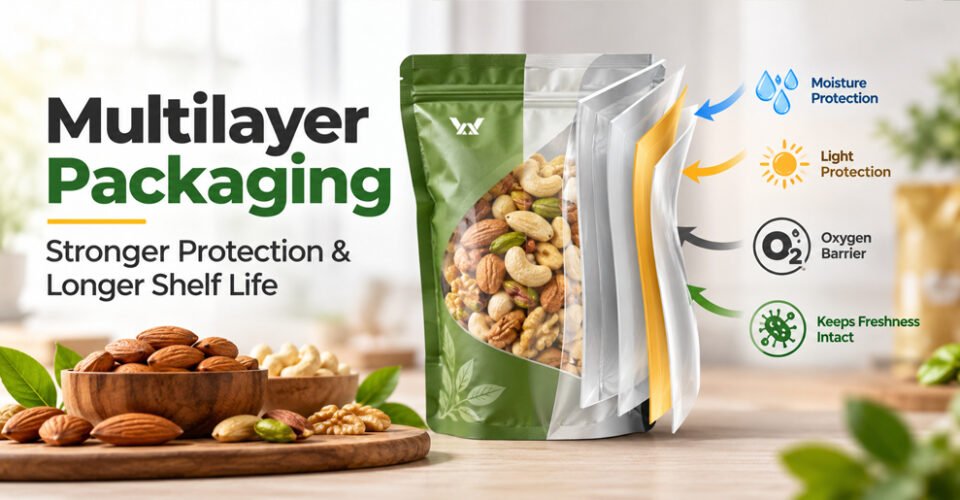
A package can look simple on the outside while doing complex work to protect the product inside.
When food and FMCG products need protection from moisture, oxygen, light, contamination, and handling damage, a single packaging material may not always be enough. This is where multilayer packaging becomes useful.
By combining different materials into multiple layers, manufacturers can create packaging that offers a better balance of protection, durability, sealing, printability, and product presentation.
For food manufacturers, exporters, FMCG brands, and packaging buyers, choosing the right structure can directly affect product quality, shelf life, transportation, and customer experience.
What Is Multilayer Packaging?
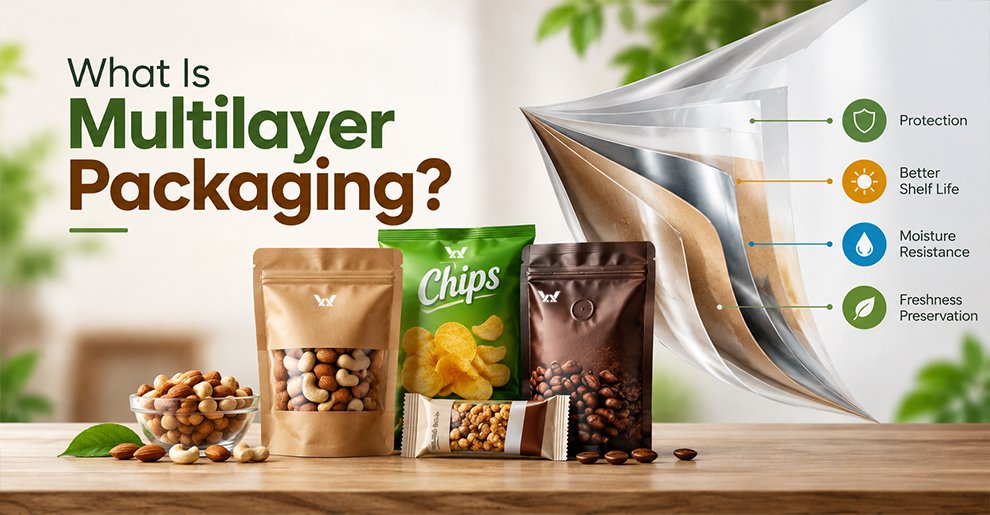
Multilayer packaging is packaging made by combining two or more material layers to achieve specific performance requirements.
Each layer can have a different function. One layer may provide strength, another may act as a barrier, while another supports heat sealing or printing.
Common materials used in multilayer structures include:
- PET – provides strength, clarity, and printability
- PE – commonly supports sealing and flexibility
- BOPP – offers strength, printability, and good appearance
- CPP – provides sealing and heat resistance
- Aluminium foil – offers strong protection against light, oxygen, and moisture
- Paper – can contribute to appearance, stiffness, and branding
The exact structure depends on the product, filling process, storage conditions, and required shelf life.
How Does Multilayer Packaging Work?
Think of each layer as having a specific job.
Instead of asking one material to provide every property, manufacturers combine materials so that the final package can deliver multiple functions at once.
| Layer Function | Main Purpose |
|---|---|
| Outer Layer | Printing, strength and appearance |
| Barrier Layer | Protection from oxygen, moisture or light |
| Inner Layer | Sealing and product contact |
| Adhesive Layer | Bonds different materials together |
This approach makes multilayer packaging especially useful for products that require stronger protection than conventional single-layer packaging can provide.
Why Does Multilayer Packaging Matter?
Packaging does much more than hold a product.
A package must protect the product throughout filling, transportation, storage, retail display, and final consumer use. If the packaging fails at any stage, product quality can suffer.
Multilayer packaging helps brands build packaging structures around these real-world requirements.
For example, a snack manufacturer may need protection from oxygen and moisture to help maintain crispness. A beverage product may need strong sealing and leak resistance. A powdered product may require protection against moisture and contamination.
The packaging structure should therefore be selected based on the product rather than simply its appearance.
Key Benefits of Multilayer Packaging
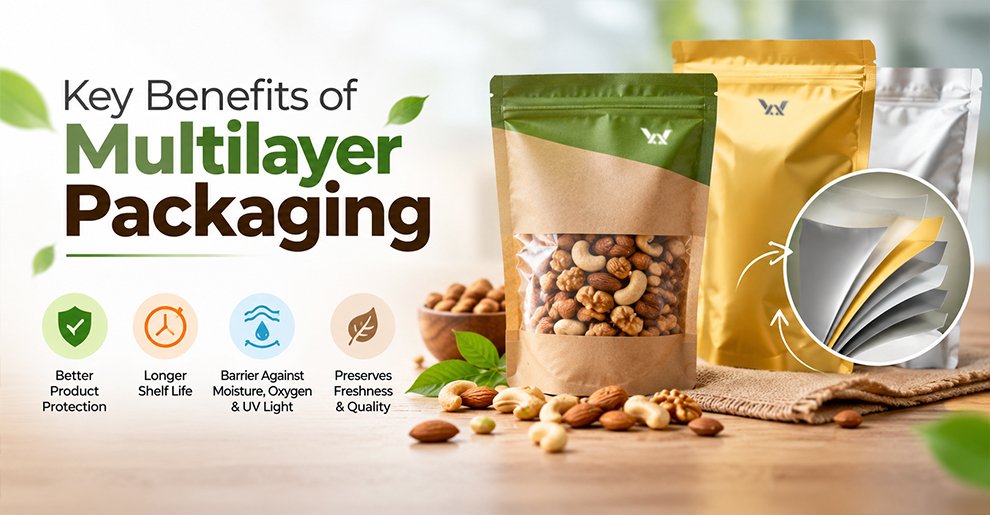
1. Better Product Protection
One of the biggest advantages is improved protection.
Different layers can help protect products from external factors such as oxygen, moisture, light, dust, and contaminants.
This is particularly important for food products where exposure to environmental conditions can affect taste, texture, aroma, and overall quality.
2. Longer Shelf Life
Shelf life is closely connected to packaging performance.
When the packaging structure provides an appropriate barrier against oxygen, moisture, light, or other external factors, it can help slow product deterioration.
For brands, this can mean more time between production and consumption while maintaining the expected product quality.
However, packaging alone does not determine shelf life. Product formulation, processing, storage conditions, and distribution also play important roles.
3. Stronger and More Durable Packs
Packaging has to survive more than a trip from the factory to the shelf.
It may experience stacking, vibration, compression, temperature changes, and repeated handling.
Multilayer structures can combine materials with different mechanical properties to create packaging that is better suited to these challenges.
4. Better Barrier Performance
Barrier protection is one of the most important reasons manufacturers choose multilayer structures.
Depending on the selected materials, packaging can be designed to provide resistance against:
- Oxygen
- Moisture
- Water vapour
- Light
- Aroma transfer
- External contamination
The required barrier level depends heavily on the product.
5. Attractive Product Presentation
Packaging also influences how consumers perceive a product.
A clean print, strong colour reproduction, smooth finish, and well-designed pouch can make a product look more professional on the shelf.
This matters because consumers often form an initial impression before they taste or use the product.
A well-designed package can communicate quality, consistency, and brand positioning within seconds.
Multilayer Flexible Packaging for Different Products
Multilayer flexible packaging is widely used when manufacturers need lightweight packaging with multiple functional properties.
Pouches, sachets, bags, and laminated films can be designed using different material combinations depending on the application. White Lotus Industries offers a range of flexible packaging pouches for different product requirements.
For example:
- Snacks may require moisture and oxygen protection.
- Spices may need aroma and moisture protection.
- Dry fruits may require strong barrier properties.
- Powdered foods may need moisture resistance and reliable sealing.
- Beverages may require leak-resistant structures and strong seals.
For spices, businesses can also consider masala packing pouches designed with multilayer structures for moisture, oxygen, aroma, and product protection.
For dry fruits, dry fruit packing pouches can provide the required balance of protection, sealing, durability, and shelf presentation.
This flexibility allows packaging manufacturers to develop structures around specific product requirements rather than relying on a one-size-fits-all solution.
Multilayer Packaging for Food and Beverages
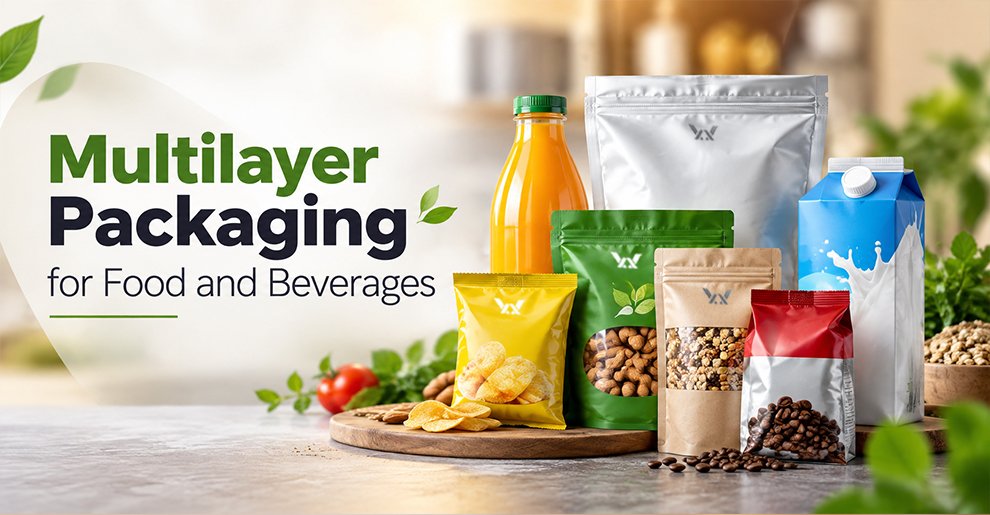
Multilayer packaging for food and beverages needs careful material selection because these products can be sensitive to moisture, oxygen, light, temperature, and handling.
Food packaging should also consider the filling process and how the package will be stored and transported.
For instance, a product that travels long distances may require a more robust structure than one sold locally.
Similarly, products exposed to humid environments may need stronger moisture protection.
The right structure is therefore a combination of material selection, product requirements, filling conditions, and expected distribution environment.
Common Challenges of Multilayer Packaging
Multilayer structures provide several benefits, but they also require careful planning.
Material Selection
Choosing the wrong material combination can result in poor barrier performance, weak seals, or unnecessary packaging costs.
Manufacturers should first understand what the product actually needs.
Cost Considerations
Using multiple materials can increase manufacturing complexity and cost.
However, focusing only on the initial packaging cost can be misleading. Packaging failures, product wastage, returns, and shortened shelf life can create much larger costs.
Recycling and End-of-Life
One of the major challenges associated with some multilayer structures is recycling.
When different materials are combined, separating them after use can be difficult.
This is why packaging development increasingly focuses on material efficiency, recyclable structures where technically suitable, and reducing unnecessary material use.
Manufacturing Compatibility
A packaging structure must work with the manufacturer’s existing machinery and filling process.
A technically strong material combination is not useful if it cannot run efficiently on the production line.
Best Practices for Choosing Multilayer Packaging
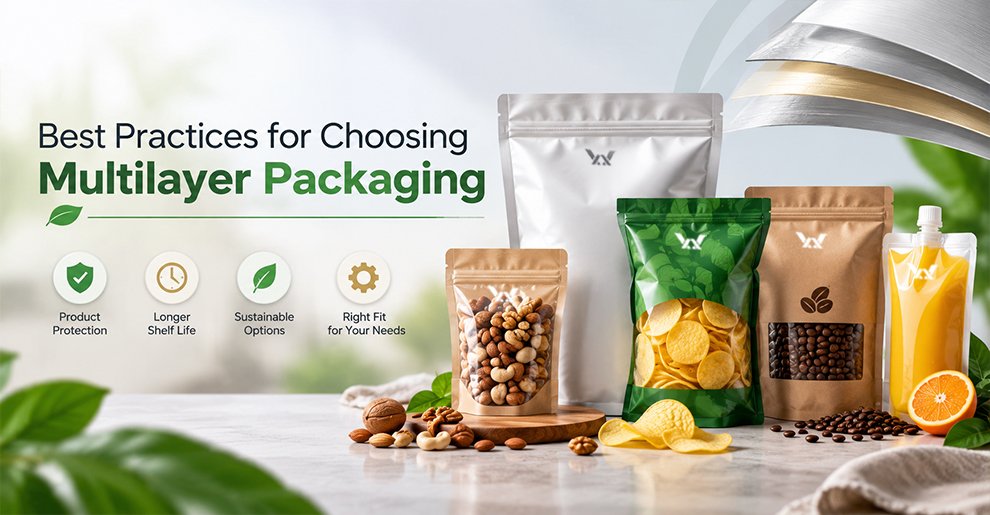
Start With the Product
Before choosing materials, understand the product.
Ask:
- Is it sensitive to moisture?
- Does oxygen affect quality?
- Does light need to be blocked?
- Does the product contain oil or fat?
- How long should it remain fresh?
- How will it be transported?
- What storage conditions will it experience?
These answers help determine the required packaging structure.
Match Barrier Properties With Shelf-Life Goals
Do not automatically choose the highest barrier structure.
The goal should be to select a structure that provides the protection the product actually needs.
An unnecessarily complex structure can increase cost without delivering meaningful additional value.
Consider Sealing Performance
Even a high-barrier film can fail if the package does not seal properly.
Seal strength, sealing temperature, filling speed, and packaging machinery should all be considered during development.
Think About Transportation
Packaging needs to survive the entire supply chain.
Consider stacking, vibration, compression, handling, warehouse conditions, and transportation distance before finalising the structure.
Balance Protection and Presentation
The package should protect the product while also communicating the brand effectively.
Strong technical performance and attractive design should work together rather than being treated as separate goals.
Multilayer Packaging and Consumer Psychology
Consumers may not understand the technical structure of a package, but they notice the results.
A pouch that looks clean, feels sturdy, opens easily, and keeps the product fresh creates a better overall experience.
This experience contributes to how customers judge the product and brand.
For premium products, packaging can also influence perceived value. A carefully designed package can make consumers feel that greater attention has been given to the product inside.
That is why packaging decisions should consider both technical performance and consumer perception.
Current Trends in Multilayer Packaging
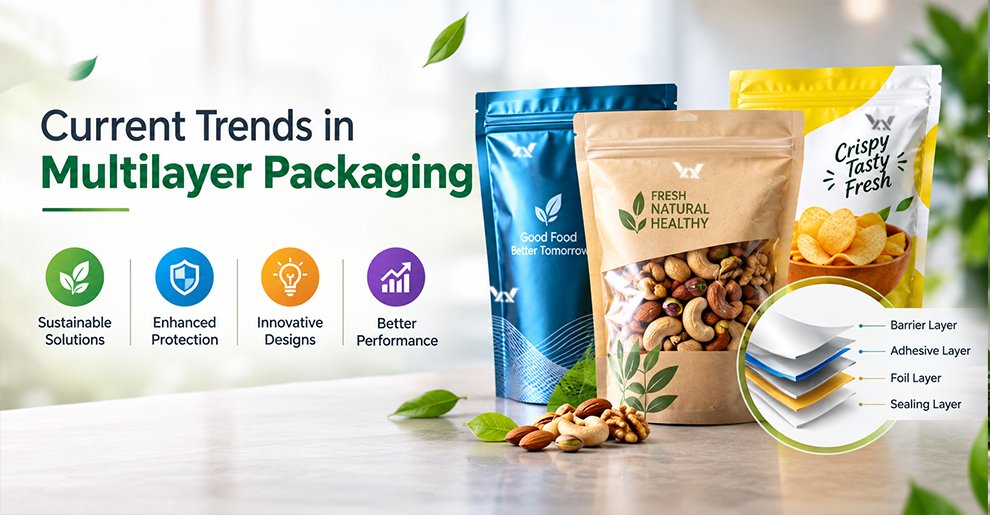
The packaging industry is moving toward solutions that balance product protection with material efficiency.
Some important trends include:
Lightweight Packaging
Brands are looking for ways to reduce material consumption without compromising packaging performance.
Lightweight structures can help reduce material usage and may also lower transportation weight.
Improved Barrier Films
Packaging manufacturers continue to develop films and structures that provide the required protection with more efficient material use.
Recyclability
Brands are increasingly evaluating packaging structures based on their end-of-life options.
Where technically and commercially suitable, recyclable packaging formats are gaining greater attention.
Better Printing and Branding
Packaging is also becoming a stronger marketing tool.
High-quality printing, finishes, graphics, and clear product communication help brands compete in crowded retail environments.
Packaging Designed Around Product Needs
Rather than choosing standard structures for every product, manufacturers are increasingly focusing on application-specific packaging.
This helps create a better balance between performance, cost, and product requirements.
Expert Recommendations for Packaging Buyers
If you are selecting multilayer packaging for your product, avoid choosing a structure based only on price.
Instead, evaluate the complete packaging requirement.
Start by identifying the product’s sensitivity, target shelf life, filling process, storage conditions, transportation requirements, and desired appearance.
Then discuss these requirements with your packaging supplier.
A good packaging partner should be able to explain why a particular structure is recommended instead of simply offering the cheapest available option.
It is also useful to test packaging before large-scale production. Seal testing, barrier evaluation, transportation trials, and shelf-life studies can help identify problems early.
The Future of Multilayer Packaging
The future of multilayer packaging will likely focus on doing more with less.
Brands still need strong protection and reliable shelf life, but they are also under growing pressure to improve material efficiency and consider end-of-life outcomes.
This means packaging development will increasingly involve collaboration between food manufacturers, packaging suppliers, material specialists, designers, and sustainability teams.
The strongest solutions will be those that balance product protection, cost, functionality, appearance, and environmental considerations.
Conclusion
Multilayer packaging provides manufacturers with a practical way to combine different material properties into one packaging structure. From improved barrier protection and stronger seals to longer shelf life and better shelf presentation, it can solve several packaging challenges at the same time.
However, the right structure depends on the product, filling process, storage conditions, transportation, and desired shelf life. For food, beverage, and FMCG brands, the best approach is to select packaging based on actual product requirements rather than simply choosing the most complex structure.
When technical performance and consumer-facing design work together, packaging can do more than protect a product—it can strengthen the entire brand experience. With the right packaging partner, such as White Lotus Industries, brands can bring together product protection, functionality, quality, and effective packaging design to meet their specific requirements.
FAQs
Q1. What is multilayer packaging?
Multilayer packaging is made by combining two or more material layers, with each layer performing a specific function. Depending on the structure, layers can provide strength, barrier protection, sealing, printability, flexibility, or resistance to external conditions.
Q2. Why is multilayer packaging used for food products?
Multilayer packaging is commonly used for food products because different layers can provide protection against moisture, oxygen, light, contamination, and handling damage. The structure can be selected according to the product’s sensitivity, required shelf life, storage conditions, and distribution requirements.
Q3. Does multilayer packaging increase shelf life?
It can help extend shelf life when the packaging provides the appropriate barrier against factors that cause product deterioration. However, shelf life also depends on formulation, processing, storage, temperature, and distribution conditions, so packaging is only one part of the overall solution.
Q4. What materials are used in multilayer packaging?
Common materials include PET, PE, BOPP, CPP, aluminium foil, paper, and specialised barrier films. The combination depends on the required strength, sealing properties, barrier performance, printing requirements, product characteristics, and intended application.
Q5. What is multilayer flexible packaging?
Multilayer flexible packaging combines different flexible materials to create a structure with multiple functional properties. It is commonly used for pouches, sachets, bags, and laminated films where manufacturers need a balance of protection, flexibility, sealing performance, lightweight construction, and attractive printing.
1 Comments
[…] multilayer packaging can combine different materials to achieve specific barrier, strength, and sealing properties. […]