
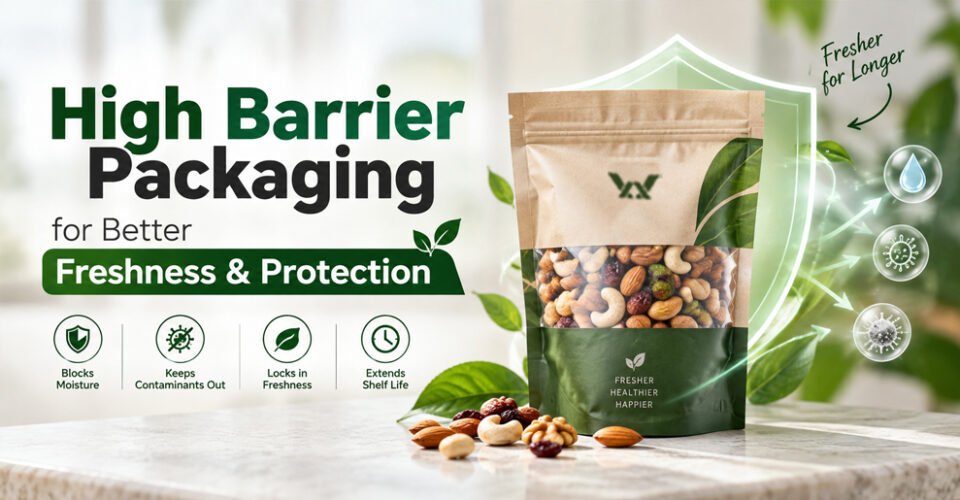
The right packaging can protect a product long after it leaves the production line.
For food and other sensitive products, packaging does much more than provide an attractive outer layer. It creates a protective barrier between the product and its surroundings.
Oxygen, moisture, light, aromas and other environmental factors can gradually affect product quality. For manufacturers, this can lead to changes in texture, flavour, appearance and shelf life.
This is where high barrier packaging becomes important.
Designed to limit the movement of unwanted gases, moisture and light through the package, high barrier structures help create a more controlled environment around the product.
For businesses handling snacks, dry foods, processed foods, powders and other sensitive products, choosing the right barrier structure can make a significant difference to product protection and overall packaging performance.
What Is High Barrier Packaging?
High barrier packaging refers to packaging structures designed to provide strong resistance against the transmission of substances such as oxygen, water vapour, light and aroma.
In simple terms, the packaging acts as a protective shield around the product.
Different products require different levels of protection. A product that is highly sensitive to moisture may need stronger moisture resistance, while an oxygen-sensitive food may require excellent oxygen barrier performance.
High barrier packaging can be created using combinations of different packaging materials and layers. Depending on the application, structures may include polymers, coated films, metallized films or aluminium foil.
The final structure is selected according to factors such as:
- Product sensitivity
- Expected shelf life
- Storage conditions
- Filling process
- Distribution environment
- Sealing requirements
- Printing and branding needs
The goal is not simply to create a thicker package. It is to create a packaging structure that provides the right level of protection for the product.
Why High Barrier Packaging Matters
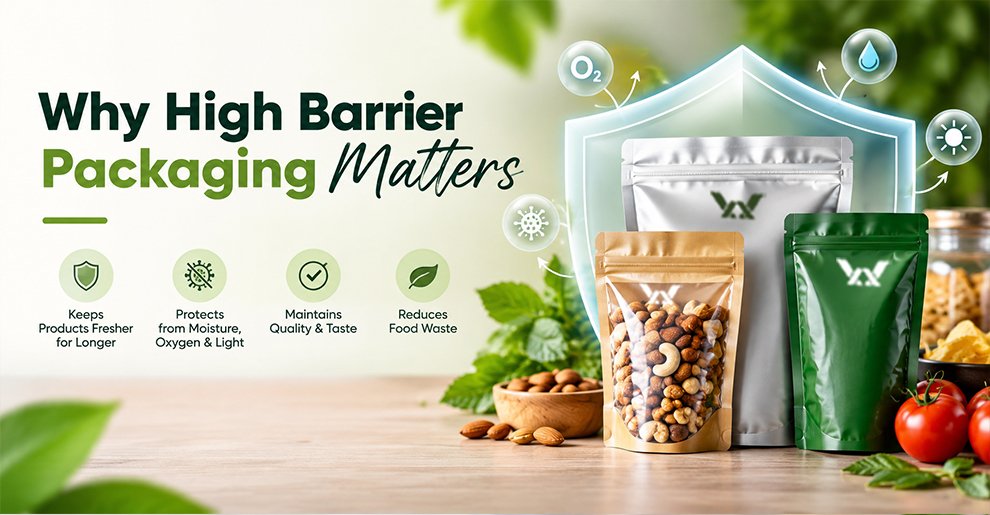
Food products can gradually lose quality when exposed to external conditions.
For example, oxygen may contribute to oxidation and flavour changes. Moisture can affect crispness, texture or powder flow. Light can also affect certain ingredients and products.
A suitable barrier package helps reduce the movement of these external elements into or out of the package.
This becomes especially important when products are expected to remain on shelves for weeks or months.
Protecting Product Quality
Consumers expect packaged food to maintain its expected taste, texture and appearance.
A strong barrier can help protect these characteristics throughout storage and transportation.
Supporting Longer Shelf Life
Shelf life depends on many factors, including formulation, processing, storage and packaging.
The packaging itself can play an important role because it controls how much exposure the product has to its surrounding environment.
Reducing Product Loss
When products lose their quality before reaching consumers, manufacturers may face complaints, returns or wastage.
Better packaging protection can help reduce these risks when the package is properly matched to the product.
Building Consumer Confidence
Packaging that keeps a product in good condition contributes to a better customer experience.
When consumers open a snack and find the expected crunch, aroma and appearance, the packaging has successfully done an important part of its job.
Key Benefits of High Barrier Packaging
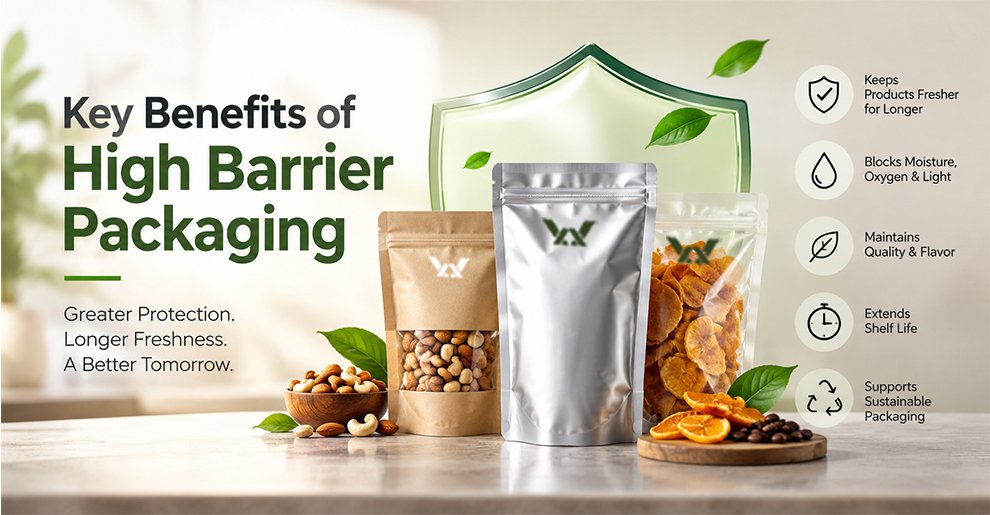
The main advantage of high barrier packaging is its ability to provide targeted protection without relying on packaging alone to solve every product-quality challenge.
Here are some of its key benefits.
1. Better Protection Against Oxygen
Oxygen exposure can be a concern for products containing oils, fats and other oxidation-sensitive ingredients.
A suitable oxygen barrier helps limit oxygen transfer and can support product stability during storage.
2. Improved Moisture Control
Moisture can quickly affect products such as biscuits, chips, powders and other dry foods.
A moisture-resistant packaging structure can help prevent unwanted water vapour transfer and maintain the intended texture.
3. Protection From Light
Certain foods and ingredients can be affected by exposure to light.
Barrier structures incorporating light-blocking layers can help reduce this exposure and provide an additional level of protection.
4. Aroma Retention
Food aroma contributes significantly to the eating experience.
Packaging with suitable barrier properties can help reduce the movement of aromas through the package, helping the product retain its intended sensory characteristics.
5. Better Shelf Stability
When oxygen, moisture and light are properly controlled, products can have a more stable environment inside the package.
However, the actual shelf life still depends on the product formulation, processing method, packaging system and storage conditions.
High Barrier Flexible Packaging: Why It Is Popular
High-barrier flexible packaging combines protective properties with the practical advantages of flexible formats.
Stand-up pouches, sachets, and other flexible packs can be designed using multiple layers, with each layer contributing a specific function.
One layer may provide strength, another may support sealing, while a dedicated barrier layer helps limit oxygen or moisture transmission.
This layered approach allows manufacturers to develop packaging around the needs of the product rather than relying on a single material to perform every function.
Flexible packaging can also offer advantages such as:
- Lightweight construction
- Efficient storage
- Convenient handling
- Large printable surfaces
- Different pouch formats
- Easy opening options
- Efficient material usage in suitable applications
For snack and food manufacturers, these characteristics make flexible formats particularly useful when product protection and presentation need to work together.
High Barrier Food Packaging for Different Products
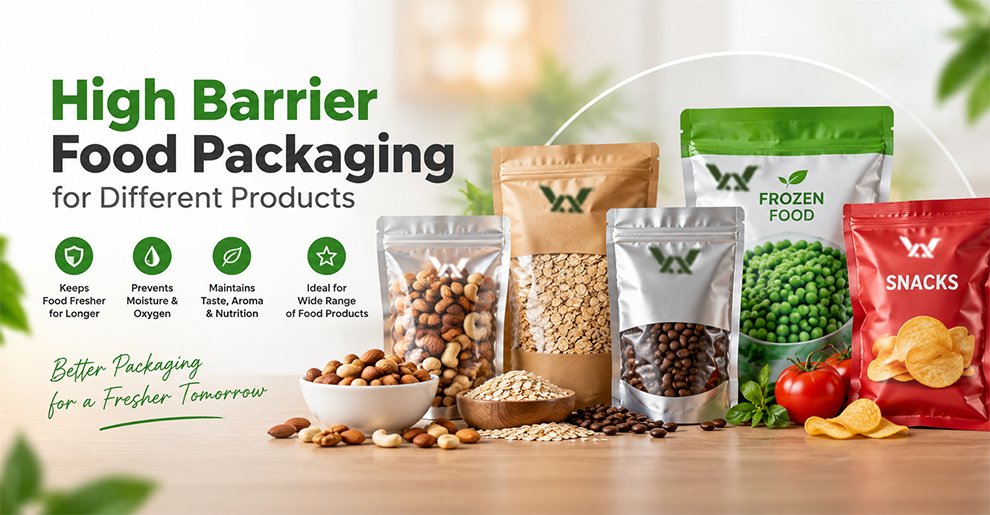
Not every food product needs the same packaging barrier.
A good packaging solution begins with understanding what can affect the product during its expected life.
| Product Type | Main Packaging Concern | Useful Barrier Property |
|---|---|---|
| Chips & Namkeen | Oxygen and moisture | Oxygen + moisture barrier |
| Biscuits | Moisture and texture loss | Moisture barrier |
| Roasted Snacks | Oxidation and aroma loss | Oxygen + aroma barrier |
| Coffee | Oxygen, moisture and aroma | High oxygen + aroma barrier |
| Spices & Powders | Moisture and aroma transfer | Moisture + aroma barrier |
| Dry Fruits | Oxygen, moisture and light | Oxygen + moisture + light protection |
| Processed Foods | Multiple environmental factors | Application-specific barrier |
The table is only a starting point. Actual material selection should be based on the product, formulation, filling conditions, desired shelf life and storage environment.
Common Challenges in Barrier Packaging
While high barrier packaging can provide strong protection, selecting the right structure requires careful consideration.
Choosing Too Much or Too Little Barrier
Using insufficient barrier protection may expose the product to unnecessary quality risks.
At the same time, choosing a structure with properties far beyond the application’s actual requirements may increase cost or create unnecessary complexity.
The better approach is to identify the product’s specific sensitivities first.
Balancing Barrier With Sealability
A packaging material must not only protect the contents. It must also form reliable seals.
A package with excellent barrier properties is of limited value if the finished pack develops weak or inconsistent seals.
Considering the Filling Process
Packaging performance can be influenced by the production line.
Factors such as filling speed, sealing temperature, product contamination around the seal area and machine settings can affect the final package.
Managing Packaging Performance During Transport
Packaging needs to survive more than just storage.
Handling, stacking, transportation and changes in environmental conditions can all place stress on the finished pack.
Best Practices for Choosing High-Barrier Packaging
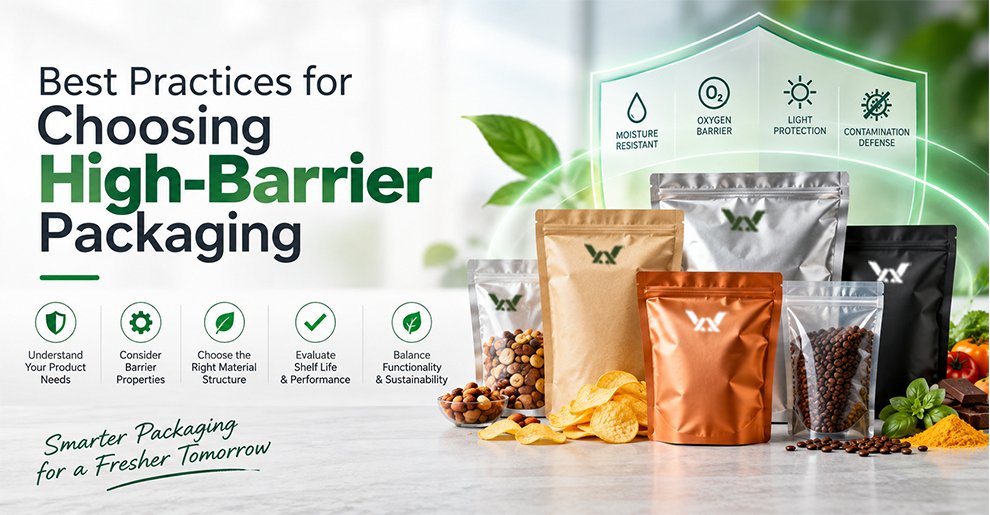
Choosing the right flexible packaging pouch becomes easier when the decision starts with the product rather than the material.
Understand Product Sensitivity
Ask what could cause the product to deteriorate.
Is moisture the biggest concern? Is oxidation a problem? Does light affect the ingredients? Could aroma escape?
These questions help determine the barrier properties required.
Define the Desired Shelf Life
The packaging structure should support the intended shelf-life target under realistic storage conditions.
Longer shelf-life expectations generally require more careful evaluation of barrier performance and package integrity.
Consider the Entire Packaging Structure
Do not evaluate a barrier layer in isolation.
The complete package includes the film structure, sealant, printing, closures where applicable, seals and manufacturing process.
All of these elements contribute to final performance.
Test Before Full-Scale Production
Laboratory and packaging tests can help manufacturers evaluate whether a selected structure performs as expected.
Depending on the application, testing may examine seal strength, barrier properties, leakage, durability and product stability.
Think About Storage Conditions
A package that performs well under controlled conditions may face different challenges during real-world distribution.
Temperature, humidity, transportation distance and warehouse conditions should be considered during packaging development.
High Barrier Packaging and Sustainability
Sustainability is becoming an increasingly important consideration in packaging decisions.
However, improving sustainability is not simply about selecting a material labelled as recyclable or using less material.
Packaging needs to protect the product effectively while also considering material use, manufacturing, transportation and end-of-life options.
Reducing food waste can also be an important part of the overall sustainability equation because spoiled food represents wasted resources, energy and production effort.
For this reason, packaging decisions should consider both product protection and environmental impact.
Where suitable for the application, manufacturers can explore lightweight structures, material optimisation and packaging formats that use resources efficiently.
The best solution depends on the product and the available recovery or recycling systems in the target market.
Industry Trends in High Barrier Packaging
The packaging industry is moving toward solutions that combine product protection, convenience, branding and sustainability.
Several trends are becoming increasingly relevant.
Lightweight Barrier Structures
Manufacturers are exploring ways to maintain required protection while reducing unnecessary material use.
The challenge is achieving this without compromising package integrity or shelf-life performance.
Improved Flexible Formats
Pouches and other flexible packaging formats continue to evolve with features such as improved opening systems, resealability and better handling.
More Sustainable Material Options
Packaging developers are increasingly investigating recyclable and lower-material structures where technically and commercially appropriate.
Better Shelf-Life Testing
Instead of selecting packaging based only on traditional specifications, manufacturers are paying closer attention to actual product-package interaction.
This encourages more application-specific packaging development.
Expert Recommendations for High Barrier Packaging
When developing packaging for a sensitive product, focus on performance rather than simply choosing the most advanced-looking material.
Start with three questions:
What needs protection?
Identify whether the product is primarily sensitive to oxygen, moisture, light, aroma or a combination of factors.
How long does it need protection?
Define the required shelf life and consider the actual distribution and storage environment.
How will the package be produced and handled?
The material needs to work with the filling, sealing, transportation and storage processes.
A packaging solution is successful when these factors work together.
It should protect the product while remaining practical for manufacturing, distribution and consumers.
Future Outlook for High Barrier Packaging
The future of high barrier packaging will likely focus on achieving stronger product protection with smarter material use.
As food manufacturers continue to look for longer shelf life, improved product quality and more convenient formats, packaging structures will need to balance several requirements at once.
Barrier performance, recyclability, lightweight construction, convenience and visual appeal are increasingly becoming part of the same packaging conversation.
For manufacturers, this means packaging development should not be treated as a final production decision. It should be considered early, alongside product formulation, shelf-life goals and distribution requirements.
Conclusion
High barrier packaging plays an important role in protecting products from environmental factors that can affect quality during storage and distribution.
By controlling exposure to oxygen, moisture, light and aromas, the right packaging structure can help maintain product characteristics and support the intended shelf life.
For food manufacturers, selecting the ideal solution requires more than choosing a material with a high barrier rating. Product sensitivity, package design, sealing performance, production conditions, storage and transportation all need to be considered.
Whether you are developing high barrier flexible packaging for snacks or high barrier food packaging for other sensitive products, White Lotus Industries can help you choose packaging solutions that are designed around your product’s specific protection and performance requirements.
FAQs:
Q1. What is high barrier packaging?
High barrier packaging is designed to restrict the transfer of oxygen, moisture, light, aromas or other external factors through the package. It is commonly used when products need stronger protection to maintain quality and stability during storage and distribution.
Q2. Why is high barrier packaging important for food?
Food can be affected by oxygen, moisture, light, and aroma loss. High-barrier food packaging helps create a more protective environment around the product, which can support quality retention and the desired shelf life when combined with appropriate processing and storage. For products such as spices and masalas, choosing the right masala packing pouch manufacturer can help businesses select packaging designed to provide the required protection against moisture, oxygen, and aroma loss.
Q3. What is high barrier flexible packaging?
High barrier flexible packaging uses multilayer or specially engineered flexible structures to provide protection against environmental factors. Pouches, sachets and similar formats can be designed with specific barrier properties according to the needs of the packaged product.
Q4. Can high barrier packaging extend shelf life?
It can contribute to longer shelf life by reducing exposure to factors that cause product deterioration. However, shelf life also depends on formulation, processing, filling conditions, package integrity and storage, so packaging should be evaluated as part of the complete system.
Q5. Which foods commonly use high barrier packaging?
Products such as snacks, roasted foods, coffee, dry fruits, spices, powders and other moisture- or oxygen-sensitive foods may benefit from high barrier packaging. The required barrier level varies according to the product’s ingredients and expected storage conditions.